drones.irish
01 / 19BRIEFGA
Investor Pitch · Confidential · Éire

Ireland's own
drone factory.

A sovereign, indigenous manufacturing capability — built on Irish soil to protect our seas, serve our people, and capture the value at home. Made in Ireland, made for Europe.

€75Mnational programme
€2.2MPhase-1 pilot line
15→150skilled jobs
30Irish use cases
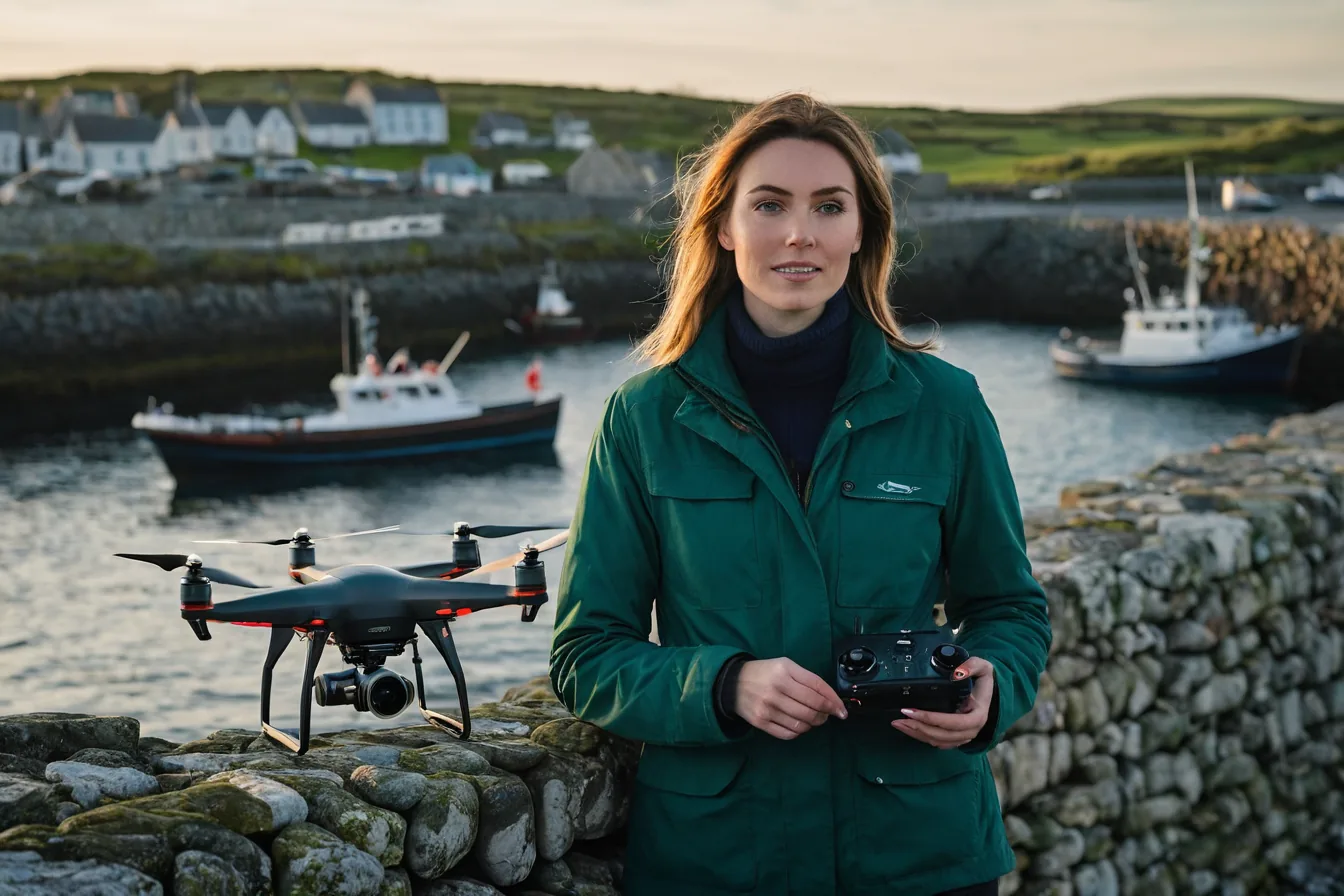
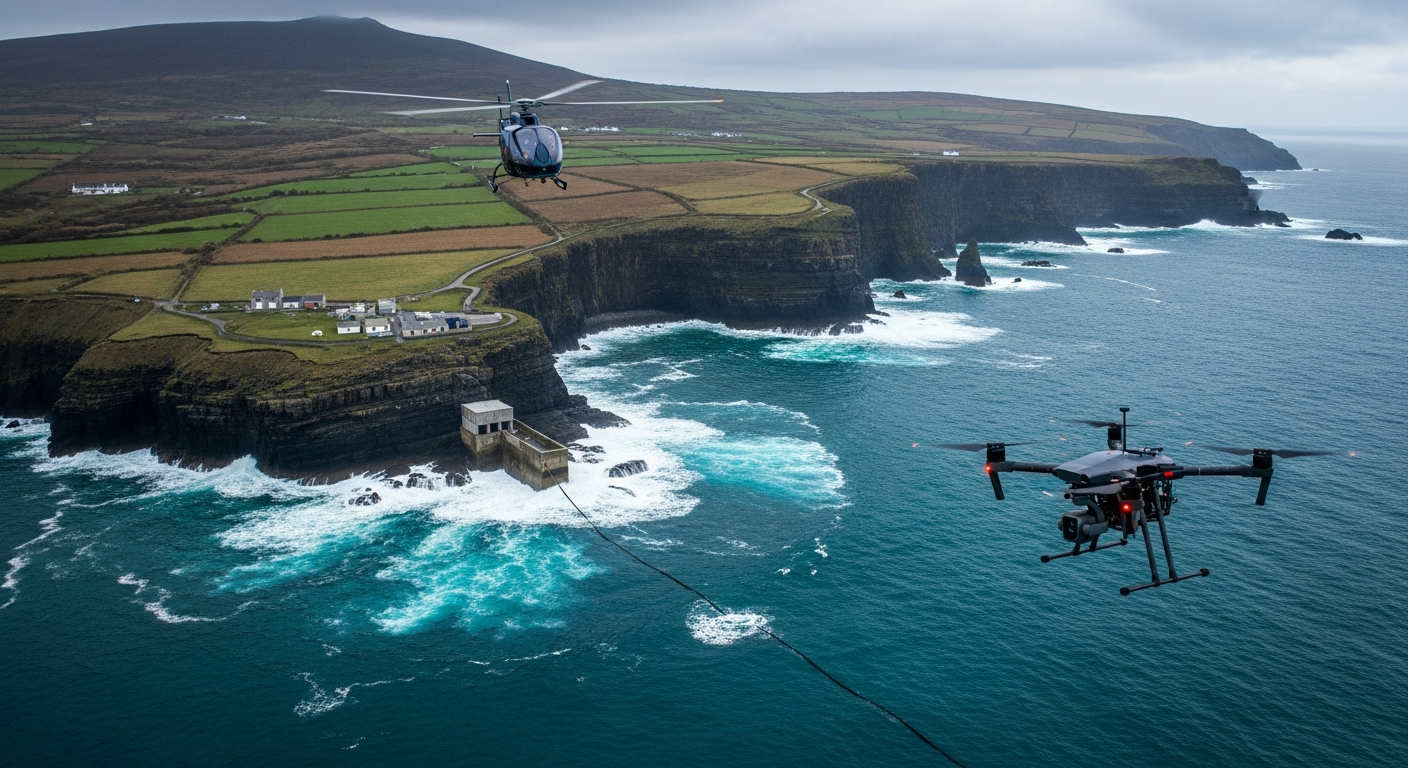
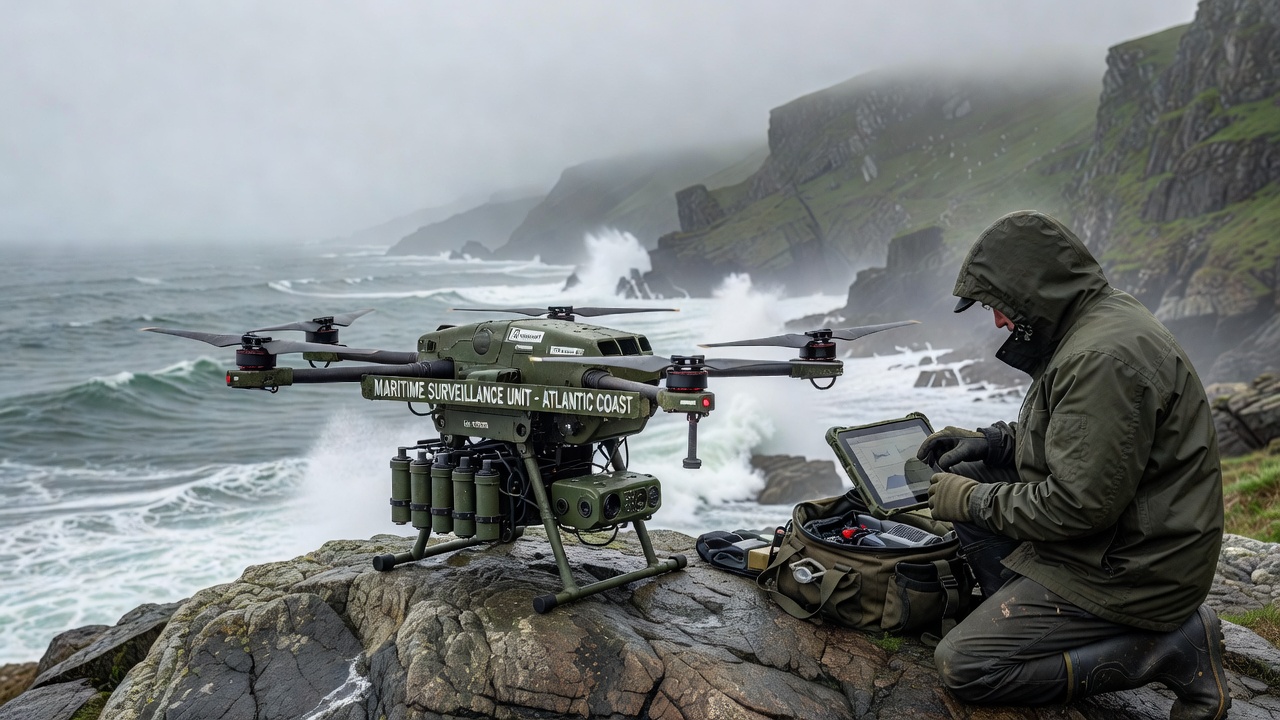
Irish Atlantic coastline near a cable landing
The State has named the need
"At the heart of this strategy is a new whole-of-government approach to protect … our maritime domain … in cooperation with … the private sector."
Min. Helen McEntee TD — National Maritime Security Strategy, Dept of Defence, 2026

The Government says the private sector has "a responsibility to play its part, complementing that of the Government." We are that partner — the indigenous capability that lets the State deliver, not just plan.
The threat is here, now

Our cables are being stalked.

  • Nov 2024 — the Russian vessel Yantar flew three drones over Irish-controlled waters, near subsea cables and a gas interconnector.
  • Jan 2025 — shadow-fleet tanker Arne dragged its anchor off Co. Mayo, beside the AEC-1 Ireland–US cable; later intercepted missing that anchor.
  • Since Oct 2023 — 11+ cables cut or damaged in the Baltic (Eagle S, Yi Peng 3, NewNew Polar Bear).
Irish Times 2024–26 · Carnegie Endowment 2025
Atlantic ocean off Ireland
Why Ireland, specifically

The world's data runs past our coast.

of N-hemisphere subsea cables near Irish waters
14cables land here (4 to N America)
~99%of global data travels by subsea cable
$10tndaily financial flows depend on them
82data centres on Irish soil
CSIS Ireland Case Study, Jul 2025 · ITU 2025
The capability gap

A sea the size of a country — almost no eyes on it.

450,000 km²EEZ — ~10× our landmass
~2naval ships operational (2023)
0.2%of GDP on defence
−50%patrol days, 2020→2024

Ireland's "seablindness" is real demand with no domestic supply. The drones to fix it are bought abroad.

CSIS 2025 · Irish Naval Service / afloat.ie
The proven answer

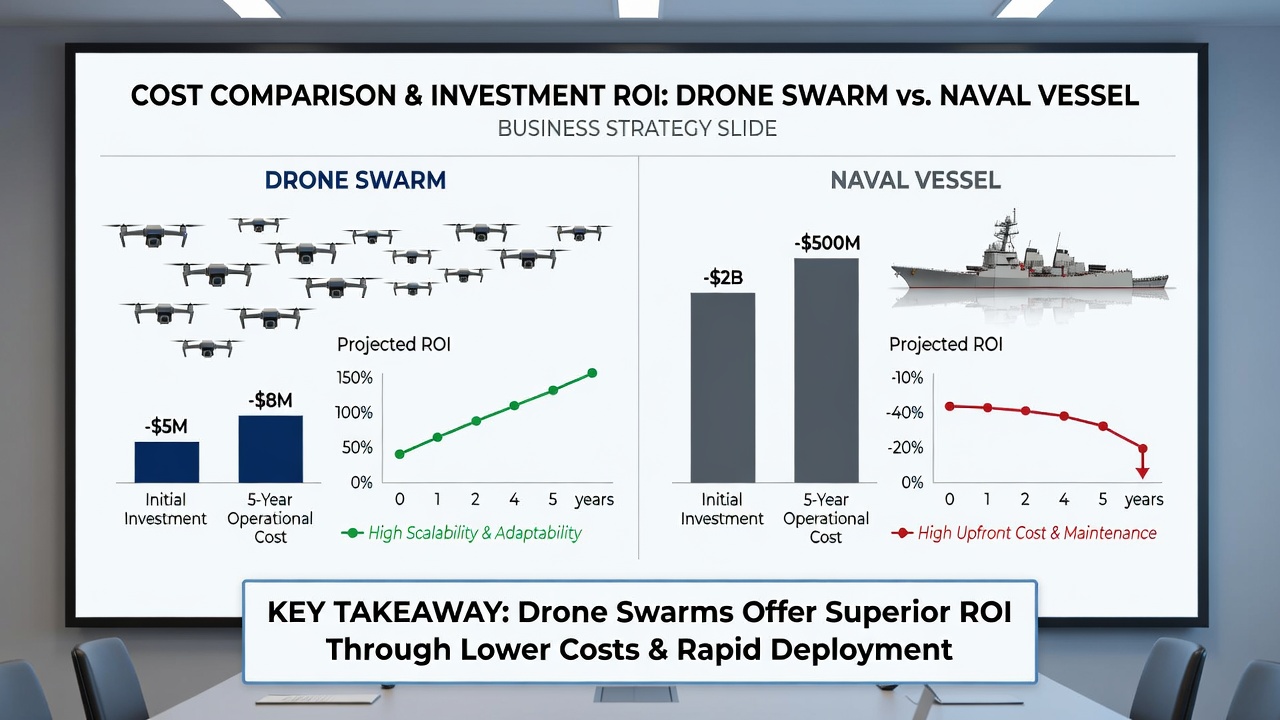
Persistent drones, not scarce ships.

  • NATO launched Operation Baltic Sentry (Jan 2025) with ~20 naval drones guarding undersea infrastructure.
  • Uncrewed systems give far lower cost-per-patrol-hour than frigates over a vast EEZ.
  • The mission — detecting slow, loitering, anchor-dragging vessels — is already demonstrated.

The capability exists. The question is who builds it — and where.

The thesis

Own the line. Capture the margin. Build it in Ireland.

Indigenous, sovereign capability — headquartered and controlled here. We build the hard part (the motor) at home, so every unit sold funds the next line, not a foreign supplier. Growth and innovation; safe and secure.

End-to-end manufacturing

One line. Five zones. 160 m².

1 · Rawmaterials 2 · Statorwinding 3 · Rotorassembly 4 · Finalassembly 5 · QC &packing
  • Sequential flow: raw stock → wound stators → balanced rotors → final assembly → full QC.
  • 3–5 operators on the floor, scaling to 15 staff.
  • ≥98% qualification rate · 4-minute cycle time. target line spec · modelled
Build the drone · step 1 of 6

Stamp the steel. Stack the core.

It starts with metal: a high-speed press punches 0.20 mm silicon-steel laminations and stacks them into the motor's stator core — thin layers, low energy loss, over 96% stacking factor.

  • Machine: progressive stamping press + in-die stacker.
  • Makes: the slotted stator core that every coil is wound onto.
Build the drone · step 2 of 6

How a drone motor is born.

1 Stamp & stack laminations
2 Insulate the core
3 Wind the copper (CNC, dLRK)
4 Terminate & surge/hi-pot test
5 Impregnate & cure
6 Bond magnets & magnetise
7 Press shaft & balance
8 Assemble & set air-gap
9 Test — Kv, thrust, dielectric
10 Integrate drone & calibrate
  • One coil per tooth — the dLRK scheme, 12 slots / 14 poles — a CNC needle/flyer machine lays enamelled copper at controlled tension.
  • Magnets are bonded into the rotor bell, then magnetised in place — cleaner and repeatable; ~4-min winding cycle, ≥98% first-pass.
  • Every motor is impregnated, cured, balanced and fully tested before it ships.
Build the drone · step 3 of 6

Set the magnets. Make the rotor.

Curved magnets are bonded into the spinning rotor bell, then magnetised in place — far cleaner and more repeatable than handling live magnets on the line.

  • Machine: magnet-bonding jig + capacitor-discharge pulse magnetiser.
  • Makes: the rotor that spins around the wound stator.
Build the drone · step 4 of 6

Press the shaft. Balance the spin.

The shaft and bearings are pressed in, then the rotating assembly is spun on a dynamic balancer — because at 5,000–30,000 rpm the tiniest imbalance ruins flight stability and bearing life.

  • Machine: servo bearing-press + dynamic balancing machine.
  • Makes: a smooth, vibration-free rotating assembly.
Build the drone · step 5 of 6

Test every motor.

Each finished motor goes on an end-of-line stand: Kv, no-load current, thrust and RPM, vibration and a dielectric safety test — pass or fail, logged to its serial number.

  • Machine: thrust/dynamometer test bench + hi-pot tester.
  • Nothing ships unverified — every unit is certified on-shore.
Build the drone · step 6 of 6

Build the drone.

Motors, propellers, speed controllers and a flight controller come together on the bench; the drone is calibrated and test-flown — and a finished Irish-made drone rolls off the line.

  • Machine: assembly jigs + ESC/flight-controller bench + prop balancer + calibration rig.
  • Makes: a complete, flight-ready drone — start to finish, in Ireland.
precision motor
Rare-earth sovereignty roadmap

Free of China's magnet monopoly.

A motor's magnets are the one part the world buys from a single country. China processes ~90% of rare earths and makes ~93% of permanent magnets — and in April 2025 it put export controls on them, spiking EU prices up to . The same magnets sit in Predator drones and F-35s.

  • Magnet-free motors already ship: BMW & Renault (wound-field), Turntide (switched-reluctance), Tesla (induction) — proof the physics works at scale (automotive precedent — not drone-validated; no affiliation).
  • Our hedge: dual-source ferrite & iron-nitride magnets (Niron, Proterial) now, and a magnet-free design path for non-flight motors.
  • Honest: high-performance flight motors still use magnets today — so this is our supply-chain insurance and R&D roadmap, not a finished claim.
CSIS 2025 · BMW / Renault / Turntide · Niron / Proterial
Buy-to-begin · the line you acquire

Everything you buy to begin.

Lamination stack prep Stator insulation CNC flyer winding Terminate & fuse Varnish & cure oven Magnetize & bond Press & balance Motor EOL test Drone integration Calibrate · QC · pack

And the materials that feed it:

Enamelled copper magnet wireSilicon-steel laminationsNdFeB magnetsPrecision bearings & shaftsESCs / flight controllersCarbon frames & props
~€0.45–1.15Mcore machines (within the €2.2M pilot line)
Windersthe single biggest capex block
10stations, raw stock → packed drone

Indicative equipment ranges from supplier research; RFQ-confirmed before the budget hardens.
From order to first drone

Fast to first unit.

Site & lease Line ordered · 120-day lead Fit-out · ~6–8 wks Commission · ~4 wks Pilot run · first units Scale · 1,000/day
  • The turnkey line's 120-day build is the critical path — siting, lease and hiring run in parallel.
  • Moving into an Údarás advance factory removes the build-a-shell delay entirely.

Lead-time estimate — modelled; confirmed on final supplier & site contracts.

Sovereign supply line

Made here. Repaired here. Owned here.

Irish today

Airframes, integration & autopilot are already indigenous; an Irish electronics base (Galway, Wexford) and a working motor-rewind trade give us a real foundation to build on.

The on-shore loop

Rewind failed stators and recover copper, test & calibrate every motor in Ireland, rebuild tooling in our own toolroom, and train operators — the durable sovereignty asset is the skill, not just the machine.

Honest on imports

Winding machinery and NdFeB magnets are imported under managed dual-sourcing (EU/US + turnkey); magnets are the strategic stock we hold. European/Irish-assembled — not "100% Irish-made".

The goal: manufacture and repair the supply line itself on the island — spares, rewinding, test, calibration and training, all on-shore.

Use what Ireland already has

Don't build a factory. Move into one.

  • Údarás na Gaeltachta leases ready advance factories in Donegal — e.g. a 1,000 m² industrial unit (+365 m² office) with three-phase power and broadband, to let now.
  • It is renewing €4.55M of roads, water and power at Gaoth Dobhair Business Park (~728 employed) — utilities you inherit, not fund.
  • Partner Ireland's existing skills: motor-rewind shops (since 1984), ÉireComposites & Versadrones airframes, Taoglas RF, TE Connectivity precision.
  • Precedent: Abbott reused the closed Hospira plant in Donegal Town — €36M, 155 jobs. We do the same: lease and repurpose, not greenfield.
Údarás na Gaeltachta · Donegal County Council · RTÉ · Irish Examiner
Where it runs, and what it costs

Built in the Donegal Gaeltacht.

DonegalGaeltacht Dublin Cork
Údarásproperty & rent in the Gaeltacht*
Grant-offsetcapital & employment support*
Skilled wagesWestern-region operator base*
EnergyIrish industrial electricity*
  • Enterprise Ireland & Údarás na Gaeltachta actively want international start-ups in the Gaeltacht — siting here unlocks the grant stack.
  • Atlantic / Western Development region; Irish-language operations become a strategic asset, not just a nicety.

* Running-cost factors — figures being confirmed against live Údarás & energy quotes.

Real sites, not a rendering

Fly the Donegal Gaeltacht.

  • Gaoth Dobhair Business Park — Údarás's flagship enterprise park.
  • Na Dúnaibh — a 1,000 m² advance unit, ready to let.
  • Donegal Town — where Abbott reused a closed plant for €36M / 155 jobs.

Open the full interactive map → · OpenStreetMap basemap
The premises

A real building, ready to fit out.

  • Gaoth Dobhair Business Park, Donegal Gaeltacht — Údarás's flagship enterprise park.
  • Serviced units with three-phase power, water and broadband; ~728 already employed on site.
  • €4.55M park-utilities upgrade under way (2025–27) — inherited, not funded by us.

Open the satellite view → · Esri World Imagery

manufacturing quality control
Supplier — pressure-tested

A vetted tier-1 turnkey OEM partner. under NDA

  • Scored 89.9 / 100 against six manufacturers on capability, longevity and compliance.
  • ≥98% qualification rate · 120-day lead time · CE-certified, BV-audited.
  • Hosts on-site client due-diligence; EU-compliance-ready, NDAA-clean sourcing path.

Scores & rates are supplier-reported, subject to our independent due-diligence audit. Identity held under NDA, disclosed only to signed parties.

Unit economics

We make the costliest part for half the price.

53–72%in-house motor cost vs import
€2.2MPhase-1 pilot line
~5 mopayback at baseline volume
1000/daydesign capacity at full ramp

Every shipment funds the factory. Margin is captured here, in Ireland.

See the full financial model & funding plan →

* Modelled from in-house factory research; to be validated against final Irish site, energy & labour quotes.
30 Irish missions

One factory, the whole island's problems.

  • Maritime & energy: subsea-cable watch · offshore-wind inspection · fisheries · coast-guard SAR.
  • Agri & environment: precision farming · forestry · peatland & carbon · flood mapping.
  • Infrastructure: grid & pipeline · data-centre · rail · bridges · ports.
  • Public safety: mountain rescue · island medical delivery · counter-drone security.
How a drone guards a cable

We watch the cable, not the deep.

  • Drones geolocate "dark" ships (AIS switched off) by their radio emissions using directional antennas — and flag loitering or anchor-dragging over a known cable route.
  • In shallow water a drone-borne magnetometer already maps the cable itself — demonstrated on real export cables.
  • Machine learning matches each signal to the specific cable segment and behaviour we have trained it to recognise.
  • Honest limit: this detects surface and near-surface vessels of interest — not silent, deep submarines.
SPH Engineering (UAV magnetometer) · CRFS / Unseenlabs (RF) · DAS research 2025
Guarding the cable, up close

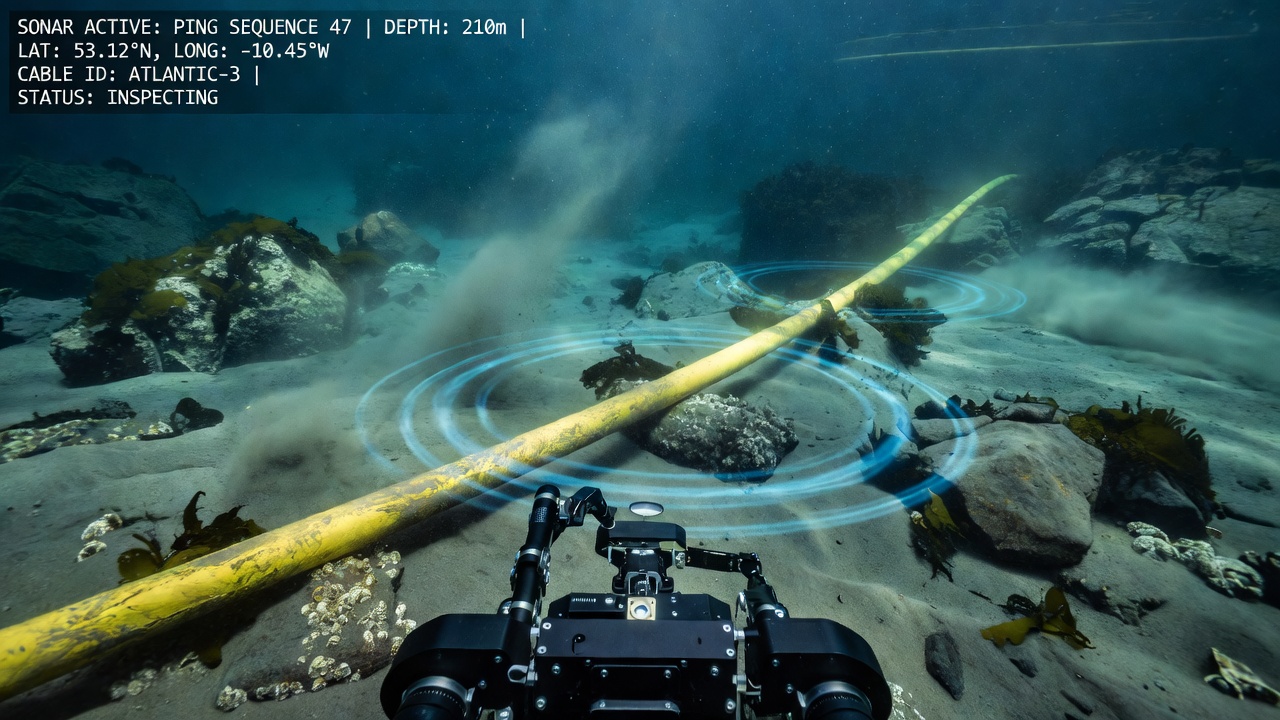
Eyes on the seabed.

  • Small ESP32-P4 sensor pods sit at a cable's weak points — landing stations, shallow crossings — watching for disturbance.
  • An autonomous underwater drone visits them, reads them by acoustic/optical link and relays up through a surface buoy (radio can't travel underwater).
  • They complement DAS — the fibre-as-sensor system cable operators already run — adding local, high-resolution spot-checks exactly where it matters.
Espressif ESP32-P4 · NKT (Distributed Acoustic Sensing) · subsea-comms research 2025
Protecting critical infrastructure

See it coming. Cue the response.

  • The threat is real: unauthorised drones over airports, ports, energy sites and critical infrastructure are a live European problem.
  • Our role is detection, early warning and cueing — a distributed LoRa sensor-net (long range, low power, low bandwidth) that spots intrusions and hands a precise cue to the responder.
  • Interception is a proven field handled by dedicated systems — external reference: Anduril Roadrunner-M and Ukraine's interceptor drones (~250–340 km/h) down slow attack drones. We integrate with such effectors; we do not build weapons.
  • Honest limit: nothing here intercepts a hypersonic missile (Mach 5+, ~6,000 km/h). Against fast threats we detect, track and cue national defences — never claiming the kill.
CSIS Missile Defense Project · TWZ · GAO 2022 · LoRa Alliance — external systems referenced, not our deliverables.
One factory, many drones R&D variant

Drones that fly — and dive.

Semi-submersible VTOL drones that cross from air into water to inspect a cable up close, then fly home.

  • Grounded in real research: Nezha (dives to ~50 m), Naviator (air↔water in under a second), AquaMAV, CRACUNS.
  • Our amphibious variant is a development programme building on these — honest: no off-the-shelf amphibious quad exists yet.
  • The hard parts are real engineering: waterproofing, buoyancy, two-fluid propellers, and comms underwater where radio can't reach.
SJTU Nezha · Rutgers Naviator · Imperial AquaMAV · JHU APL CRACUNS
What one line can build

One line. A whole family of drones.

01 Cable-watch maritime UAV
02 Amphibious cable-diver (VTOL)
03 Offshore-wind blade inspector
04 Long-range fisheries patrol
05 Coast-guard SAR float-drone
06 Island medical-delivery
07 Oyster / aquaculture monitor
08 Precision-grassland multispectral
09 Livestock / herd counter
10 Slurry / nutrient mapper
11 Forestry tree-planter
12 Truffle / canopy mapper
13 Peatland carbon-MRV
14 Transmission-line inspector
15 Gas-pipeline sniffer
16 Data-centre thermal patrol
17 Pharma cold-chain courier
18 MedTech inter-site shuttle
19 Port / harbour security
20 Bridge / viaduct surveyor
21 Wide-area flood mapper
22 Water-quality / algal-bloom
23 Wildfire / gorse detector
24 Heritage LiDAR mapper
25 Construction / BIM progress
26 Quarry volumetrics
27 Counter-drone interceptor
28 Tethered persistent-watch
29 Swarm relay / comms node
30 Stratospheric-comms tender
Built on Ireland's 30 real missions · amphibious & multi-role variants off one motor line
Autonomy at the edge of the sea

Keep the swarm working, far from shore.

The hardest part of working at sea is staying connected and autonomous when radio fades and the deep blocks signals.

  • Fail-safe autonomy: each drone completes its task and returns home even if the link drops.
  • Resilient over-the-horizon comms — a complementary Hyperlog concept, satsoft.ch, explores stratospheric relays to keep an offshore swarm online. concept
  • Gentle on people and nature: dropping medicine to an island, or quietly watching an oyster farm in a sheltered bay.
satsoft.ch (early-stage concept · no partnership implied) · Hyperlog
Made by us · run by us

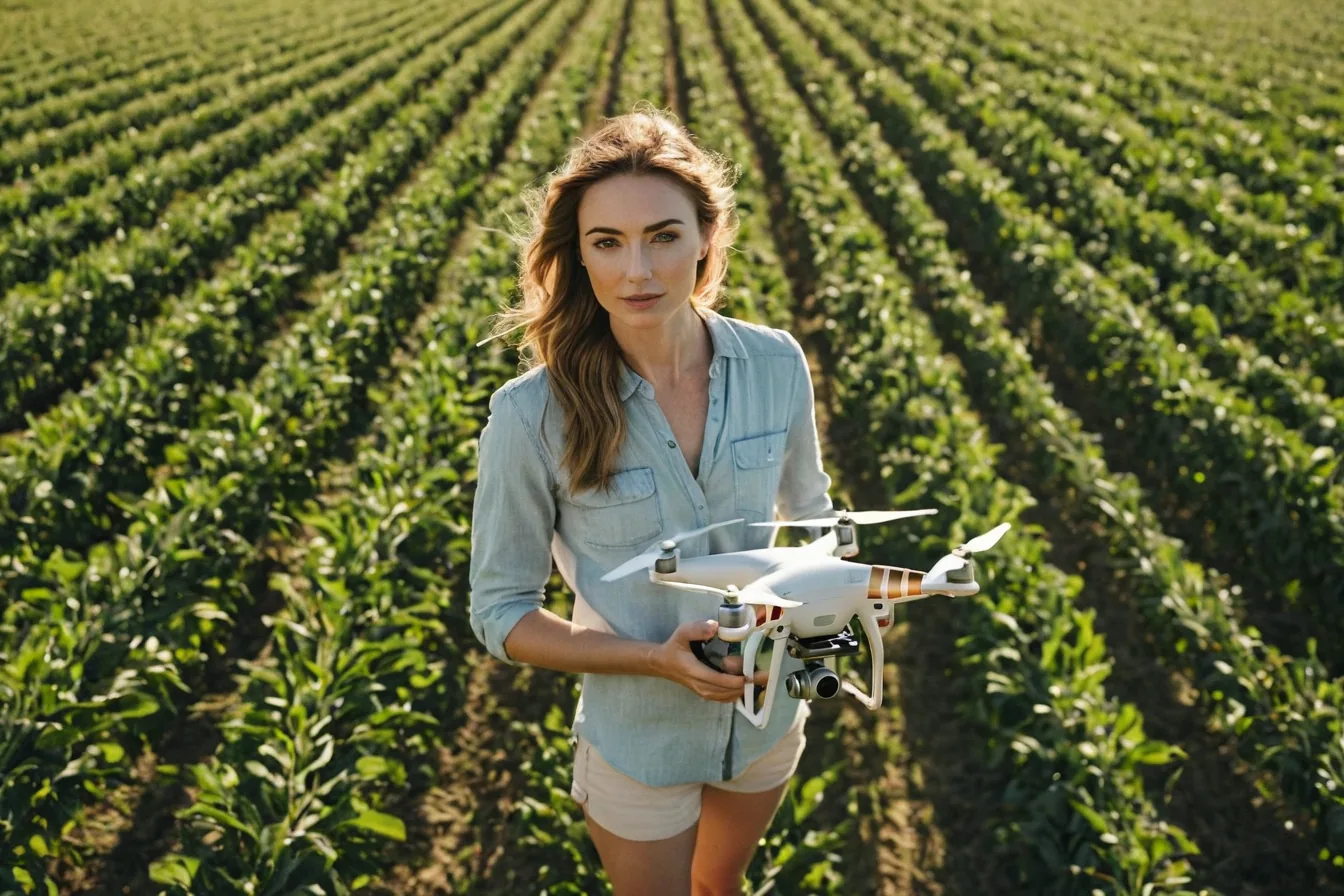
One operator. A swarm at her command.

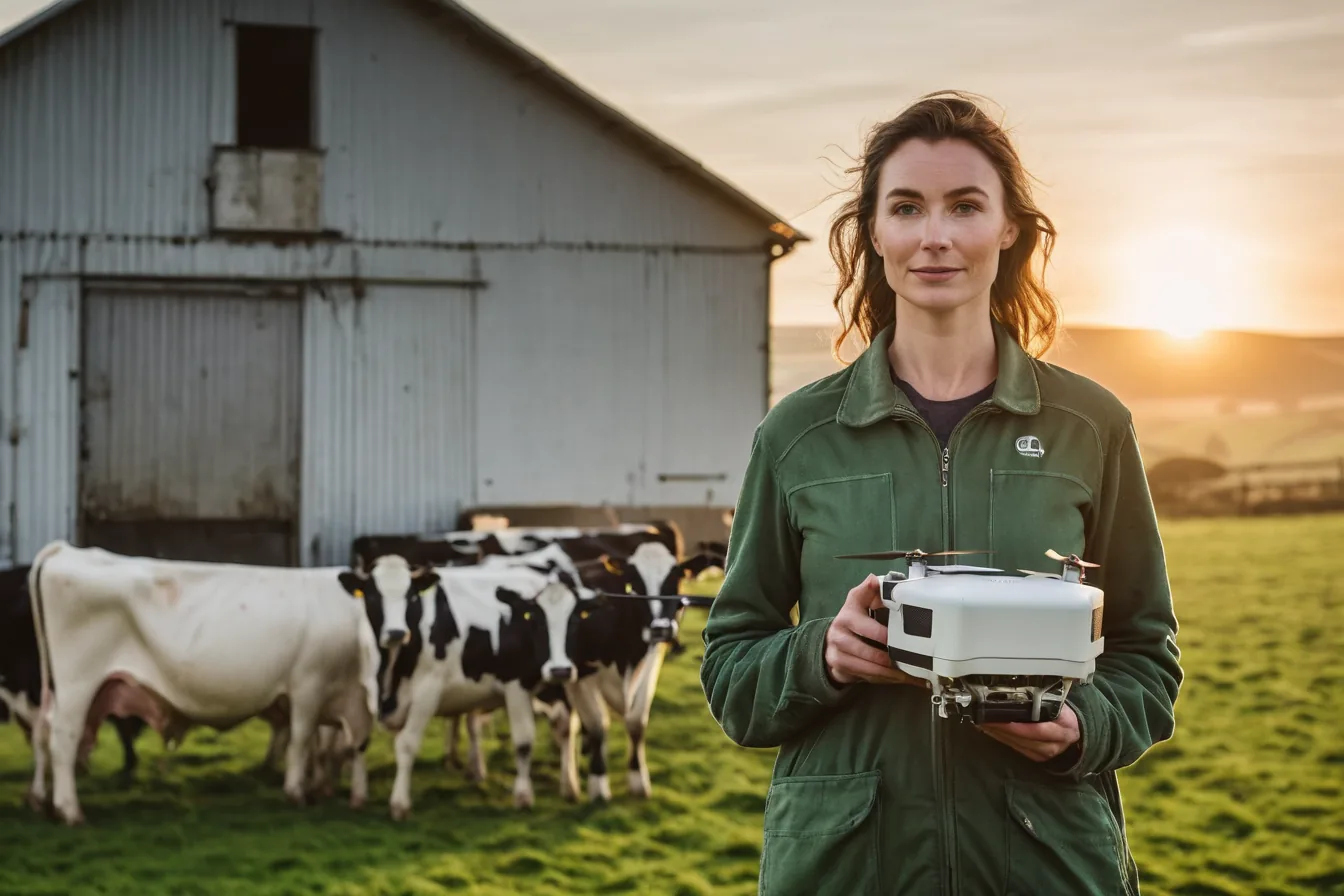
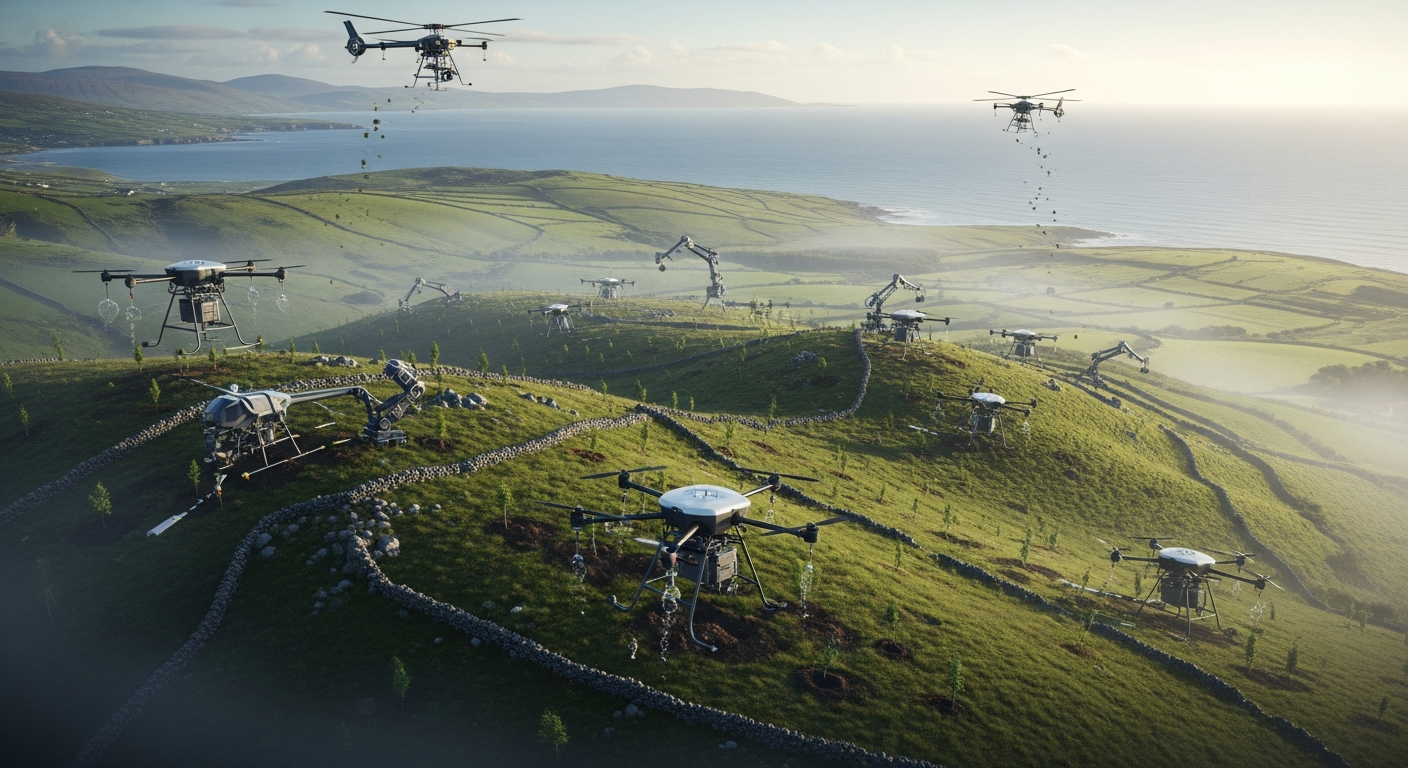
From a phone in a Donegal field, one operator directs a fleet of drones — fire-and-forget. They fly their loops, sow truffle spores and tend the crop, then return to base to reload — again and again, like a printer head laying down a page, until the job is done.

  • Real jobs, real skill: accessible, well-paid drone-operations work in the Gaeltacht — open to everyone.
  • Agritech that travels: precision farming and truffle cultivation, run from Ireland for fields worldwide.
  • Swarm autonomy: the direction of the technology — one human, many drones, every loop precise and repeatable.
Agritech — precision farming & truffle cultivation — is a flagship Irish drone mission.
Tending the tide

Watching over the oysters.

Ireland farms ~130 oyster sites — over €44M a year, with Donegal and Waterford about 60% of it.

  • A survey drone maps every trestle and bag, spotting biofouling, growth and early mortality from the air.
  • It tells the farmer when and where to turn, grade and harvest — taking the hardest guesswork out of the work.
  • Honest: the heavy lifting stays human; the drone is the eyes and the analytics, not the muscle.
Bord Iascaigh Mhara (BIM) · UAV aquaculture-mapping research
Energy at sea

Powered by the sun and the swell.

  • Solar: ultra-thin perovskite panels recharge the onboard battery on the surface — real drones already fly charge-then-fly cycles (44 W/g, JKU Linz).
  • Wave & wind: the proven route to months — even a year — at sea (Saildrone, Wave Glider).
  • Metal–seawater fuel cells (magnesium / aluminium) carry energy as metal for long one-way missions; the anode is renewed on land.
  • Straight talk: the battery is charged by sunlight and harvested energy — never by the seawater itself. No free lunch, only good engineering.
Nature Energy (perovskite UAV, JKU Linz) · MIT Open Water Power · Liquid Robotics / Saildrone
Serving the real economy

A swarm for Ireland's biggest exports.

Ireland exported a record €223.7bn in goods in 2024 — pharma alone €99.9bn (45%); the US takes 39%.

Pharma & medical€99.9bn · 45%Cold-chain & inter-site delivery · plant thermal inspection
Chemicals€145.3bn · 65%Reactor, flare-stack & tank-farm survey without shutdowns
Machinery & tech€31.4bn · 14%Data-centre security & external thermal inspection
Food & dairy€15.0bnPrecision grassland & herd / welfare monitoring
Drinks (whiskey)~€1bn*Barley-estate & bonded-warehouse watch
CSO Ireland — Trade in Goods 2024 · *whiskey: Bord Bia / industry figure
The cost lever

The motor is where the money is.

$14–22kimported ag-drone (DJI / XAG)
~$37in-house motor*, small/mid class
4–8motors in every drone
53–72%in-house cost vs import

We don't claim a $37 drone. We make the costliest part — the motor — for roughly half to two-thirds of import cost: about $37 per small/mid unit at our cost, and a drone needs four to eight of them. That subsystem is where local production wins.

DJI / XAG retail · MAD / T-MOTOR motor prices · in-house model. *Motor manufacturing cost — motor-to-motor, not motor-to-drone; the $14–22k is a finished imported drone, the ~$37 is one of its 4–8 motors.
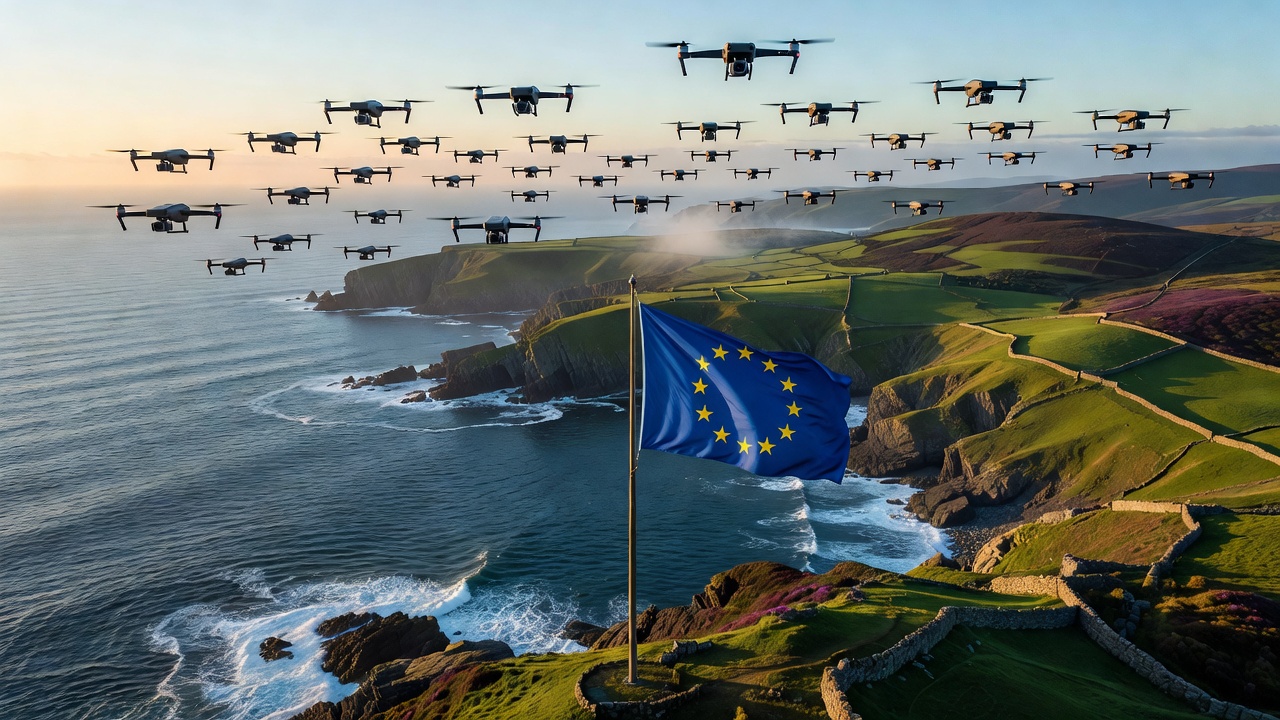
Made by us, for us

Irish hands. Irish drones.

Real jobs in the Gaeltacht — neighbours building world-class drones at home, taking pride in tools made by their own community for their own coast, their own fields, their own people.

  • Skilled, well-paid manufacturing work where it is needed most.
  • Every drone sold keeps skills, margin and confidence in Ireland.
European precedent

The model already works in the EU.

EU Motors (Kraków, Poland) runs an NDAA-aligned line at 100,000 motors / month, with a second plant in Florida. Sovereign drone manufacturing is deployable on European soil — Ireland is next.
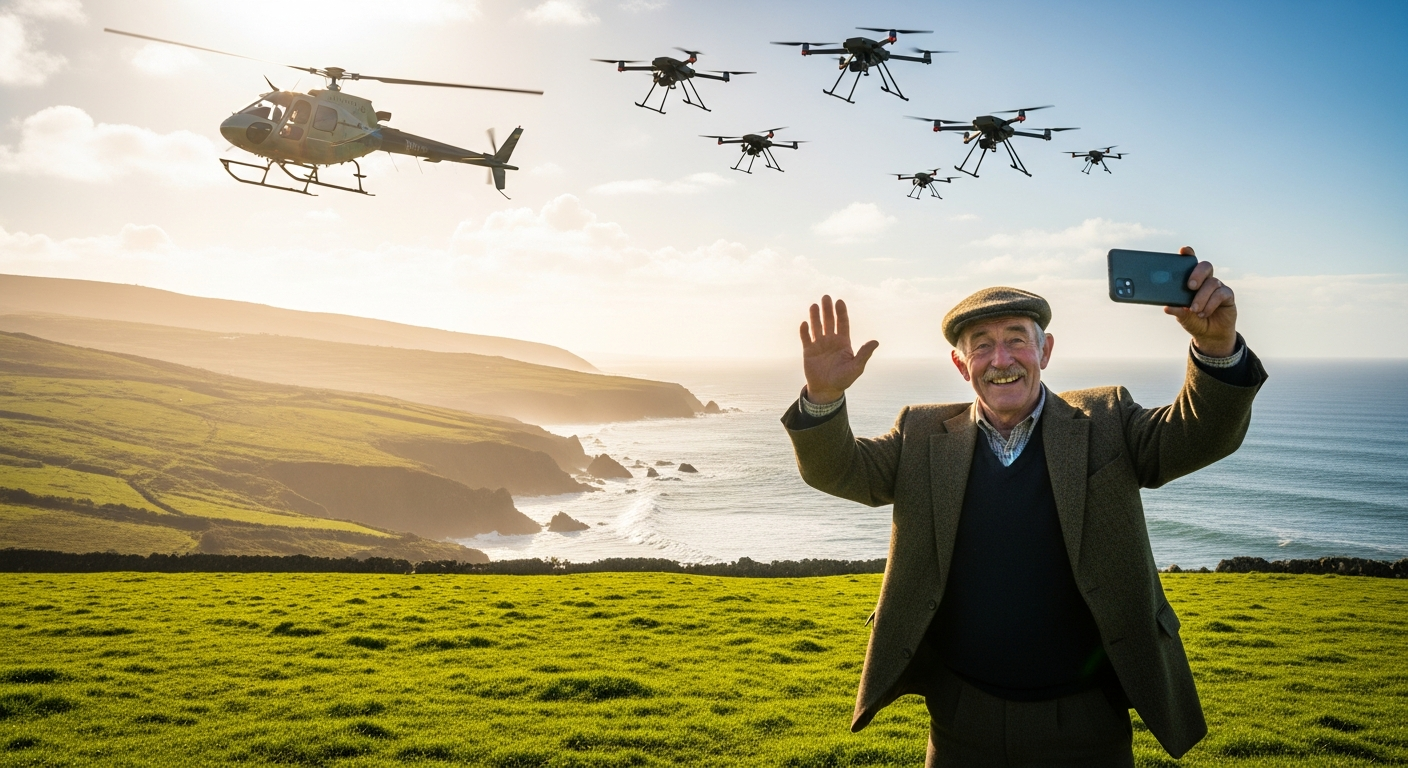
Irish countryside
The raise · phased to €75M

A €75M programme, built in phases.

Phase 1 proves the line for ~€2.2M. The full €75M scales it to a national capability — multiple lines, magnet-free & amphibious R&D, and an export-ready fleet. Indigenous Irish grants form the non-dilutive base (Enterprise Ireland + Údarás na Gaeltachta — we qualify as a High Potential Start-Up); equity, EU and strategic capital scale it.

Non-dilutive Irish grants — HPSU · Údarás · Smart Regions · WDCbase
HPSU Feasibility €30k · Údarás capital+employment · Smart Regions (€30.6M fund) · WDC €50k–1M
Innovative HPSU Fund + seed / Series-A equity€0.8–1.2M+
EI co-funded equity, matched by private investors
Strategic & industrial investorsscale equity
the bulk of the €75M — partners who buy the sovereign-supply thesis
EU dual-use & EDF R&D programmesR&D
magnet-free + amphibious development, as an EU consortium partner
Debt & asset financeplant
buildings, machines & working capital against confirmed orders

Phase 1 ~€2.2M (modelled) → €75M programme. Enterprise Ireland · Údarás na Gaeltachta · NWRA · WDC · EU/EDF, 2026. Full model →

Indigenous grants first (non-dilutive); equity, EU and strategic capital scale to €75M. Figures modelled — to be set with advisers.
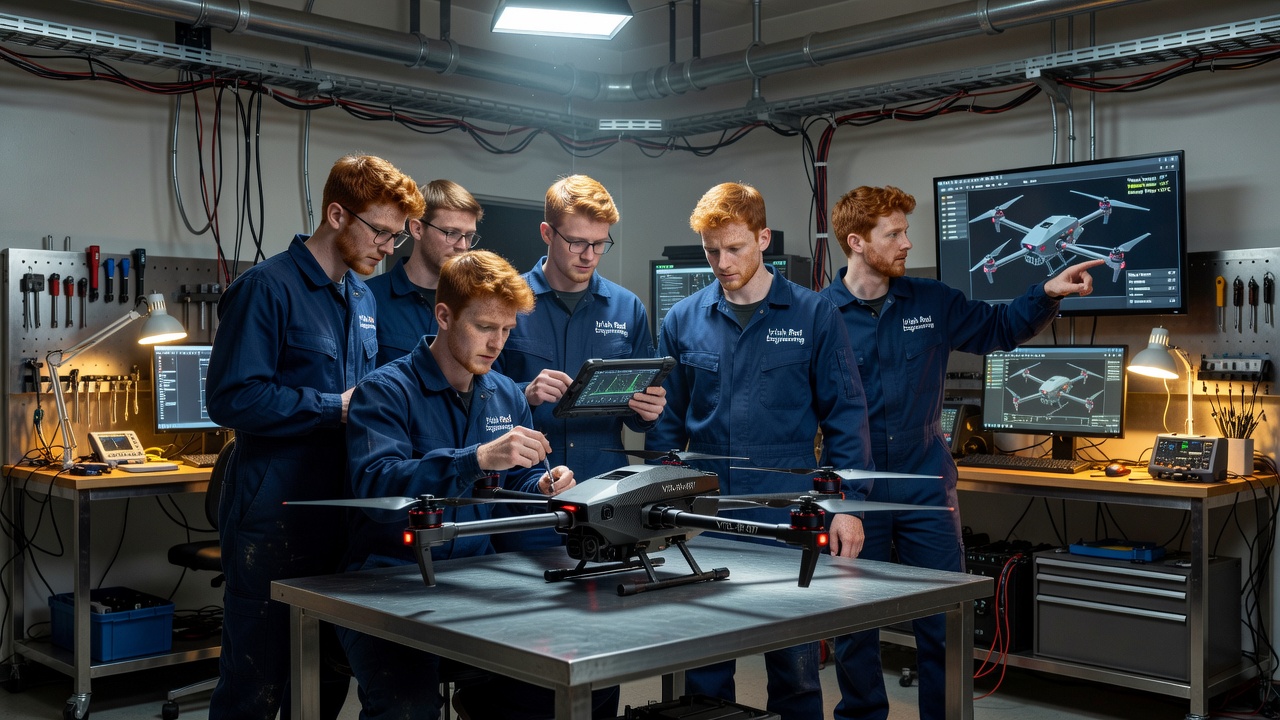
The €75M · to the euro

Capital follows proof, not promises.

€2.2MPhase 1 — prove (1 line)
€30MPhase 2 — scale (8 lines)
€42.8MPhase 3 — moat & frontier
€75Mnational capability

Each phase unlocks the next only once it has paid out: a costed pilot line, then multi-line scale, then the R&D and electronics frontier. Every euro below is traced to a machine, a building, a job or an order.

Phased programme · all figures modelled, to be validated against final quotes. Full model → /pitch/financials/

National return · the numbers, plainly

What Ireland gets back.

€60MRevenue (Year 5)
€20MEBITDA (Year 5)
150Skilled jobs
~5 moPayback
Gross margin (Year 5)Gross margin (Year 5): 62%62%EBITDA margin (Year 5)EBITDA margin (Year 5): ~33%~33%Exchequer return vs grantExchequer return vs grant: ~80%~80%Modelled 5-year figures, to be validated. Hover/tap a bar.
€8–12MExchequer return (tax+PRSI)
€31.6BExport market (2033)
€14–22kImport substitution / drone
€2.2MSelf-funding pilot

In plain terms: a €75M national programme builds a self-funding factory that returns tax, jobs, exports and import-substitution to the State — and Ireland keeps the patents.

Modelled 5-year figures, to be validated. Revenue · gross margin · EBITDA · payback · Exchequer return · GVA — standard measures, plainly shown.

The bottom line — the State funds it once and earns it back in tax, jobs and exports — while owning the IP.

Who buys · funded demand

The buyers are already funded.

Irish Defence Forces & maritime security€1.7bn plansubsea-cable watch, counter-UAS, EEZ — sovereign, NDAA-clean
Local authorities & emergency services€50–150k pilotsinspection, flood mapping, search & rescue — the repeatable entry contract
Agri & truffle growers~€42k/ha/yrmonitoring, carbon-MRV, anti-theft — agriculture alone is transformative
Offshore wind & energy operatorsrecurringblade, platform & cable inspection across Atlantic arrays
EU export market€31.6B by 2033Germany > France > UK — hungry for non-Chinese, NDAA-clean drones

Honest status: these are funded demand segments and pipeline — the budgets exist and the need is named, but these are not yet signed contracts. Modelled.

In plain terms — the money to buy is already budgeted; we supply what the State and the market are funded to need.

Use of funds · where every euro goes

No black boxes. A line for each euro.

8 motor production lines: EUR16M Cert · tooling · SMT · academy · WC: EUR20M PCB → compute frontier: EUR12M 2nd Gaeltacht site + cluster: EUR10M Magnet-free · amphibious R&D + IP: EUR8M Fleet / drones-as-a-service: EUR6M Strategic magnet + copper stock: EUR3M €75M programme 8 motor production lines€16M Cert · tooling · SMT · academy · WC€20M PCB → compute frontier€12M 2nd Gaeltacht site + cluster€10M Magnet-free · amphibious R&D + IP€8M Fleet / drones-as-a-service€6M Strategic magnet + copper stock€3M

Modelled €75M allocation. Equipment supplied by a tier-1 turnkey OEM partner (under NDA). To be validated against final quotes.

Real machines · real prices

One line, ~€800k of machines.

6x winding cells6x winding cells: EUR222k€222k Integration · controls · sparesIntegration · controls · spares: EUR121k€121k VPI impregnation + ovenVPI impregnation + oven: EUR110k€110k Bearing press + assemblyBearing press + assembly: EUR75k€75k 3x EOL test stands3x EOL test stands: EUR70k€70k Pulse magnetiser + fixturePulse magnetiser + fixture: EUR55k€55k 2x balancing machines2x balancing machines: EUR46k€46k Kitting / handlingKitting / handling: EUR46k€46k Vision / AOIVision / AOI: EUR37k€37k Surge / hi-potSurge / hi-pot: EUR18k€18k

Equipment ≈ €800k. With fit-out of a leased Údarás unit (€250k), first inventory & working capital (€650k) and a certification/contingency share (€500k), an all-in line is ~€2.2M.

€800kequipment / line
€2.2Mall-in / line
300/hrmotors wound (peak)
weeksmachine payback

Market ranges (winders $6.5k–$80k ea; SMT line $200k–$800k). Supplier under NDA. Modelled, to be validated.

Unit economics · the punchline

One machine. The whole plan.

€37kone winding machine
300/hrmotors wound (peak; 100–300)
~€60margin / certified motor
28kmotors the whole Year‑5 plan needs

A €37k machine winds 100–300 motors an hour. The entire Year-5 plan — ~€60M revenue, ~4,000 drones, ~28,000 motors — is roughly one machine's annual output. It pays for itself in under a thousand motors — a few days.

So the machine is never the constraint — demand, certification and execution are. That is why most of the €75M is market access, IP and working capital, not machines.

Throughput: industry data (100–300 small stators/hr). Margin & volumes modelled, to be validated.

The efficiency engine

One person, ~30 machines.

~1,000motors / day / line
~€0.33labour cost / motor
~$37in-house motor cost*
~5 momodelled payback

A near-lights-out line: 1.5 FTE runs ~30 automated machines at ~250,000 motors/yr, so labour is ≈ €0.33 a motor — the margin moat. We train, not staff: a few deeply-skilled Gaeltacht operators, the hardest thing to copy.

EU-Motors Poland precedent (100k motors/mo). *In-house motor cost, small/mid class — not a finished-drone price. Modelled.

Where the revenue comes from

Four engines, not one bet.

Irish State & Defence Forces€1.7bn planmaritime security, counter-UAS, EEZ — sovereign, NDAA-clean supply
30+ domestic civil missionsrecurringinfrastructure, agri, flood, emergency — local authorities & utilities
Export swarm€223.7bn economyserve where Ireland already earns (US 39%, EU) — EU/NDAA-compliant
Drones-as-a-servicesubscriptionfleet financing + SLA — recurring revenue, not just unit sales

Diversified demand — funded State need, civil missions, exports and recurring service — so no single customer can stall the programme.

€1.7bnIrish defence plan
€223.7bnexport economy
€15–20kper precision drone
6–8motors / drone

CSO exports 2024 · Defence Forces capital plan 2025 · 30-mission grid (this deck). Modelled.

What Ireland grows & exports

Ireland is grown on grass.

DairyDairy: €6.3bn€6.3bnMeat & livestockMeat & livestock: €4.3bn€4.3bnPrepared consumer foodsPrepared consumer foods: €3.4bn€3.4bnDrinks (whiskey >€1bn)Drinks (whiskey >€1bn): €2.1bn€2.1bnHorticulture & otherHorticulture & other: ~€2.9bn~€2.9bnIrish food, drink & horticulture exports 2024 = €17bn (record), ~€19bn incl. non-edible. Source: Bord Bia.

Ireland exports €17bn of food & drink — led by €6.3bn of grass-fed dairy. Yet 56% of the land is grass and just ~12% is cropped. The drone job here is grassland & clover reseeding, tillage spot-work, forestry planting and high-value new crops — protecting the country’s biggest food export.

Bord Bia 2024 · CSO land use (grassland ~56%, tillage ~300,000 ha).

For Ireland — a daily drone over every field defends the €6.3bn dairy export that bad grass-weather keeps threatening.

A drone for every tractor

It rides shotgun.

The drone doesn’t replace the tractor — it complements it. While the tractor does the heavy ground work, the drone flies the field every day, sends the farmer a live crop-health map, catches stress two weeks before it shows, and spot-treats or seeds what the tractor can’t reach — at a third of the cost and no soil compaction.

~$5/acdrone vs ~$15/ac tractor
20–30%less chemical
+5–10%yield (no compaction)
1 seasonpayback

We lend a hand: finance it like a tractor, or sell it as a service — hardware plus a daily-visuals subscription. For the farmer, lower inputs and higher yield; for drones.irish, a sale and recurring monthly revenue per farm.

Drone $5–9/ac vs tractor ~$15/ac; capex ~$30–40k vs ~$500k; multispectral NDVI 2-week early warning. Industry data, modelled.

Commercially — every Irish farm becomes a hardware sale plus a recurring daily-monitoring subscription.

Where the money actually is

Don't sell motors. Sell drones.

Bare small motorBare small motor€3 In-house motor costIn-house motor cost€37 Certified precision motorCertified precision motor€120 Finished precision droneFinished precision drone€15–20k Revenue per unit (log scale) · the money is in certified motors & finished drones · modelled

Bare small motors are a commodity — rivals sell them for ~€3, so that is not our game. The value climbs from a €120 certified motor (~€60 margin) to a €15–20k finished precision drone — 6–8 of our motors plus integration. Owning the motor is the margin floor; selling the drone is the 20×+ multiplier. Tap a bar for the detail.

FPV motor ~$2.9 (bulk) · certified/heavy motor ASP ~€120 · ag/inspection drone €15–20k (DJI Agras-class). Modelled.

5-year projection · illustrative

Margin compounds with scale.

€0M €15M €30M €45M €60M Y1 revenue EUR0.5M€0.5MY2 revenue EUR3.5M€3.5MY3 revenue EUR9M€9MY4 revenue EUR28M€28MY5 revenue EUR60M€60MY1Y2Y3Y4Y5 Revenue EBITDA

Drivers: own-the-motor margin × 1-operator:30-machines × multi-line scale × export pull. Conservative on price, aggressive on efficiency.

Every number modelled, to be validated against final quotes — not a forecast or a guarantee.

The return to Ireland

The State funds it once — and earns it back.

Employment taxes: EUR 8-12M€8–12MEmployment taxesEmployer PRSI: EUR 2-3M€2–3MEmployer PRSICorporation tax: EUR 3-4M€3–4MCorporation taxImport substitution: tens of EURMtens of €MImport substitution *Import substitution scales with volume — indicative. 5-yr cumulative, modelled.

Grants are returned through tax and jobs within a few years — and whatever margin remains is reinvested into Irish jobs, so the country compounds the benefit.

Irish CT 12.5% · employer PRSI ~11.05% · CSO/Revenue bases. 5-yr cumulative, modelled.

We stress-tested our own economics

Is it smart?

Why it's smart

  • Capital-light: a €37k machine underwrites millions in drone revenue; the whole plan needs ~one machine of winding.
  • Value capture: own the motor as the margin floor, sell the €15–20k drone for the multiplier.
  • Sovereignty premium: EU/NDAA-clean, on-shore certified — buyable where Chinese product isn't.

The honest risk

  • Not bare small motors: rivals sell at ~€3 — we must sell certified motors & finished drones.
  • The real bottleneck is demand, certification and working capital — not making.
  • So we fund market access, IP and inventory first — exactly where the €75M goes.

An honest plan beats a loud one. The economics work because we climb the value chain — and we've costed the risk in, not out.

Total transparency · public money, publicly accountable in deployment

Every penny, accounted for.

Our AI expense-audit engine (pingwage / OverCaml) monitors every euro of programme spend — especially State and grant money — categorising it, reconciling it to orders, and flagging anomalies, aligned with EU public-funds transparency. No penny goes unnoticed.

Governance commitment — engine in deployment. Aligned with EU transparency norms for publicly-supported programmes.

Proprietary Irish IP patent pending

A moat others must license.

Adaptive motor-winding processpatent pending · IEin-process quality control — the cost & yield edge
Rare-earth-free silent propulsion motorpatent pending · IEno China magnets · low acoustic & radio signature
Transmedium air / water propulsionpatent pending · IEone platform, two domains — a category with no off-the-shelf rival
Marine-grade rotor & certified propulsion cartridgepatent pending · IEfield-swappable, traceable — the interface others build to

Five Irish patent applications protect the inventive steps behind the line — filed first, in Ireland. We name the areas, not the claims: the detail stays confidential until granted, so novelty is preserved.

5 short-term Irish patents (IPOI) · areas only · full specifications held in the confidential data room.

Proprietary Irish IP · OverCaml prior-art due diligence examiner-checked

Narrowed to a novel core.

5 attorney-review filing candidates: each claim was narrowed against Irish and worldwide prior art across multiple design-around waves, until a skeptical adversarial examiner panel found no single anticipating reference. Hover any patent to read its claim, what distinguishes it, and the residual risk an attorney must still assess.

Inventors: Nathaniel Timmis · Michael Gerard Lynch

Method and Apparatus for Closed-Loop Adaptive Needle Winding of Brushless Drone-Motor Stators with In-Line Fill-Factor Verification examiner-novel

PF-DR-01 · 12 claims · IPOI short-term patent (10-yr) - incremental process innovation, fast/low-cost; EPO/PCT designating IE for the apparatus claims. · narrowed vs Irish/EP/WO/US art

A method of winding a brushless DC motor stator for an unmanned aerial vehicle in which a needle-winding head deposits magnet wire into stator slots while an optical and tension-sensing subsystem measures, in-line and per slot, the achieved copper fill factor and wire lay; a controller compares each measurement against a per-slot target and adaptively adjusts needle trajectory, wire tension and turn count for the remaining slots within the same stator, such that a target fill factor is achieved without a separate i

Independent claim 1 (narrowed)
1. A method of in-line, closed-loop needle winding of a stator for a brushless DC propulsion motor of an unmanned aerial vehicle, the stator having a plurality of internal teeth defining respective slots, the method comprising: (a) depositing magnet wire into the slots tooth-by-tooth with a needle-winding head driven by a multi-axis actuator according to a per-slot winding plan that specifies, for each slot, a needle trajectory, a wire-tension set-point and a turn count; (b) for each slot, immediately after that slot is wound and while the stator remains clamped at the winding station, acquiring an in-line, per-slot estimate of the achieved copper fill factor of the just-wound slot by (i) capturing a structured-light or telecentric optical image of the just-wound, conductor-occupied slot and segmenting it to yield an apparent slot-facing occupied-conductor area, and (ii) independently computing a deposited-copper volume for that slot from a time-resolved wire-payout-length count accumulated over the deposition of that slot multiplied by the known bare-conductor cross-sectional area and corrected for elastic elongation using the wire-tension transducer signal integrated over that deposition, and (iii) fusing (i) and (ii) by using the deposited-copper volume of (ii) to resolve out-of-plane and under-layer conductor stacking that is occluded from the slot-facing image of (i), the in-line per-slot fill-factor estimate being computed as the fused occupied conductor volume divided by the known slot volume, and a residual between the optical apparent area of (i) and the payout-derived deposited volume of (ii) being retained as an in-situ lay-quality signal indicative of conductor bird-nesting; (c) maintaining a parametric, recursively-updated model relating needle trajectory, wire-tension set-point, turn count and slot geometry to achieved copper fill factor, and updating coefficients of the model from the per-slot estimate and the lay-quality signal of step (b) after each wound slot using a recursive estimator, the model being seeded from coefficients persisted from a previously wound stator of a different motor geometry and converging to the present stator geometry within the winding of that single stator; (d) comparing the per-slot estimate to a per-slot fill-factor target and, for at least one not-yet-wound slot of the same stator, adaptively re-optimising, using the updated model, at least the needle trajectory and the wire-tension set-point of the winding plan for that not-yet-wound slot, including redistributing a measured cumulative fill deficit or surplus of already-wound slots across the remaining not-yet-wound slots so as to minimise predicted deviation of the completed stator from a target stator fill factor, subject to an actuator constraint and to a per-turn maximum-tension constraint that bounds insulation strain on the magnet wire below an enamel-cracking limit of the wire; and (e) before completing winding, halting and rejecting the stator when the updated model predicts that the attainable stator fill factor, given the remaining slot capacity and the said constraints, falls below a threshold selected such that the completed stator meets a specified continuous thermal current rating of the unmanned-aerial-vehicle propulsion motor, and otherwise binding the resulting per-slot fill-factor profile and per-slot lay-quality signal to a unique stator identifier as a traceable manufacturing record, whereby the target stator fill factor is approached by intra-stator correction without removing the stator from the winding station and without a separate post-winding inspection station.
What distinguishes it
  • Fused volumetric fill estimate, not 2D image alone: the in-line fill factor is computed as occupied conductor VOLUME / slot VOLUME, where volume is recovered by fusing the slot-facing optical area with an independently computed deposited-copper volume (payout-length x bare-conductor cross-section, corrected for elastic elongation via the integrated tension signal). US9403325B2 and US5573200A use a 2D image only (for alignment/lay, or pass/fail sorting) with no depth/volume recovery; the claim's volumetric fusion is absent from all cited art.
  • Telecentric/structured-light image is of the CONDUCTOR-OCCUPIED wound slot, used to recover occluded under-layer stacking. US12126225B2 (GM) uses a telecentric lens but on the BARE slot BEFORE winding to measure slot depth/width geometry and burrs; it never measures achieved copper fill of a wound slot and has no payout-volume fusion. The distinguishing step is recovering occluded already-wound conductor, which a pre-winding bare-slot inspection cannot address.
  • Optical-area vs payout-volume RESIDUAL retained as an in-situ lay-quality (bird-nesting) signal feeding the control model. No cited reference derives a lay-quality signal from the disagreement between an optical area and a payout-derived volume; tension loops (US7997521B1) close on tension alone and image inspectors (US5573200A) only sort.
  • Cross-geometry-seeded recursive model that converges within the winding of a SINGLE stator. The model is seeded from coefficients persisted from a stator of a DIFFERENT motor geometry and self-tunes within one part. Preset/open-loop winders (US12476524B2 Rainbow Robotics, US11962207B2 Beta Air, US8028396B2, EP0553899A2) carry no in-line fill model and no cross-geometry self-seeding; this defeats a pure aggregation/obviousness combination.
  • Conservation-of-copper deficit/surplus REDISTRIBUTION across remaining not-yet-wound slots within the same stator, bounded by a per-turn maximum-tension constraint set below the wire's enamel-cracking limit. This intra-stator closed-loop re-planning of the controlled variable (fill) is absent from every reference: the fill-goal references (US12463510B2, US8918986B2, US12170466B2, US10742084B2, EP1283583A2, EP1562276A2, WO1992001327A1, US20230179034A1 Hyundai die-cast bars) achieve fill purely by conductor geometry/preform/compaction with no measurement and no feedback.
  • Predictive reject-BEFORE-completion rule whose threshold is tied to a specified continuous thermal current rating of the UAV propulsion motor. US5573200A rejects only AFTER winding by good/bad sorting; the claim halts mid-part based on a model-predicted attainable fill linked to a downstream thermal-performance spec, which no cited reference discloses.
Residual risk (for patent-attorney review)
The claim is genuinely novel over every located reference under 102/EPC 54 - no single reference discloses the fused optical-area-plus-payout-volume per-slot fill estimate, the cross-geometry-seeded model that converges within one stator, the conservation-of-copper intra-stator redistribution, or the thermally-keyed reject-before-completion rule. The princip
Full specifications & prior-art evidence →
Salt-Fog-Resistant Permanent-Magnet Rotor Assembly with Encapsulated Magnet Retention for Marine Unmanned Aerial Vehicles examiner-novel

PF-DR-02 · 12 claims · IPOI short-term patent for the assembly; full-term national / EPO for the encapsulation process if examination supports breadth. · narrowed vs Irish/EP/WO/US art

A permanent-magnet rotor for a marine UAV motor in which NdFeB magnets are retained against a rotor back-iron by a conformal polymer encapsulation that simultaneously forms a continuous corrosion barrier and a magnet-retention sleeve, the encapsulation being keyed to axial features of the back-iron so that retention does not depend on adhesive bond-line integrity alone. A method of forming the assembly and a motor incorporating it are disclosed.

Independent claim 1 (narrowed)
1. A permanent-magnet rotor for a brushless motor of a marine unmanned aerial vehicle (UAV), comprising: a back-iron carrying a plurality of NdFeB permanent magnets, the back-iron defining axial keying features; a conformal polymer encapsulation covering the magnets and flowing into and solidifying within the keying features, the encapsulation forming both a continuous corrosion barrier over the magnets and a retention structure mechanically interlocked with the keying features such that magnet retention is provided independently of any adhesive bond between magnet and back-iron; a barrier-integrity sensing network comprising at least a first electrically conductive serpentine tracer trace and a second electrically conductive serpentine tracer trace embedded within the encapsulation at, respectively, a first radial depth and a second, shallower radial depth measured from an outer surface of the encapsulation toward the magnet surface, both tracer traces overlying the magnets, being electrically isolated from the magnets and the back-iron, and terminating at respective contacts accessible from a rotor end face, wherein an electrical parameter of each tracer trace, selected from trace resistance and trace-to-back-iron impedance, exhibits a monotonic change when salt-laden moisture penetrates the encapsulation to the radial depth of that trace, such that the time order in which the second, shallower trace and then the first, deeper trace exhibit said monotonic change yields a measured estimate of an ingress-front depth and an ingress rate through the corrosion barrier before the barrier is breached to the magnet surface; a rotor-angle reference derived from a commutation, Hall-sensor or encoder signal of the motor, wherein the sensing network samples said electrical parameter synchronously with rotor angular position so as to localize the ingress to an angular sector of the rotor associated with a particular one or group of the magnets; and a rotating electrical interface coupling the contacts to a motor controller, the motor controller being configured to compute, from the measured ingress rate and a rotor-temperature signal, a remaining barrier thickness for the localized angular sector and to derate a flight-power envelope of the UAV by an amount selected such that the remaining barrier thickness is maintained above a centrifugal-retention threshold defined as the minimum encapsulation thickness required to retain, at the rotor's then-current rotational speed, a corrosion-detached magnet fragment against centrifugal force, the controller commanding a reduction of said rotational speed when the computed remaining barrier thickness approaches the centrifugal-retention threshold.
What distinguishes it
  • Multi-depth tracer set (at least two serpentine traces at different known radial depths in the encapsulation) yielding a quantitative ingress-front depth and ingress RATE, not a binary breach flag. Sikorsky US20110210014A1/EP2350610A1 places its noble-metal electrode array in a single plane on a substrate surface (time-of-wetness/conductivity), Apple US9752999B2 is a binary high/low-resistance switch, and Lockheed US8659908B2 is a binary breach/deformation conduction-path change - none discloses depth-stratified traces measuring an ingress front advancing through a barrier before breach.
  • Rotor-angle-synchronized sampling using the motor's existing commutation/Hall/encoder signal to localize ingress to a specific angular sector / specific magnet group. No cited reference involves angle-resolved sensing on a rotating member: Sikorsky/Apple/Lockheed sensors are on static substrates or covers, and P&W US8095324B2 senses rotor flux from a fixed external loop (it does not embed a sensor in, or angularly resolve damage within, the rotor's corrosion barrier).
  • A centrifugal-retention control law: the derate is bounded so remaining barrier thickness stays above the minimum thickness needed to hold a corrosion-detached NdFeB fragment against centrifugal force at the current RPM, with active speed reduction as that threshold is approached. P&W's controller flags a developing fault and Apple's comparator triggers a generic protective shutdown, but neither computes a speed-dependent mechanical-retention margin from a measured corrosion-ingress rate; this control law is specific to a spinning encapsulated PM rotor and is absent from all cited art.
  • Coupling of an embedded-in-barrier corrosion-depth sensor to a UAV flight-power envelope via a rotating electrical interface. The base assembly (keyed non-adhesive retention + dual-function conformal corrosion-barrier encapsulation - CA2783842A1, WO2002049188A2, US9775974B2/US9931493B2, US6452301B1, US6847145B2, WO2016003309A1, DE102011119512A1, wet-pump family) carries no sensing at all; the integration of depth-resolved, angle-resolved breach sensing inside that rotating barrier and into flight-power management is the non-trivial combination.
Residual risk (for patent-attorney review)
The base assembly (keyed/interlocked non-adhesive retention plus a dual-function conformal corrosion-barrier polymer encapsulation on an NdFeB back-iron) is fully anticipated by multiple references and contributes no novelty; novelty rests entirely on the added sensing/control limitations. The original single-trace embedded breach sensor + threshold-derate c
Full specifications & prior-art evidence →
Gust-Anticipating Field-Oriented Motor Controller Using Airframe-Mounted Differential Pressure Sensing for Maritime Drones examiner-novel

PF-DR-04 · 12 claims · IPOI short-term patent for the control method; EPO/PCT for the integrated ESC-sensor architecture. · narrowed vs Irish/EP/WO/US art

A field-oriented controller for a UAV propulsion motor that receives a differential-pressure signal from airframe-mounted ports sensing local airflow and uses an anticipatory feed-forward term to pre-adjust motor torque before a gust-induced body-rate error develops, reducing attitude excursion in gusting wind compared with feedback-only control. An electronic speed controller, method and UAV are disclosed.

Independent claim 1 (narrowed)
1. A method of controlling a plurality of propulsion motors of a multirotor unmanned aerial vehicle (UAV), each propulsion motor being a permanent-magnet synchronous motor driven by a respective electronic speed controller (ESC) executing field-oriented control (FOC) in which a quadrature-axis (q-axis) current command sets motor torque, the method comprising: (a) acquiring, from an array of at least four differential-pressure ports distributed about the airframe at mutually different stand-off distances forward of the rotor plane and arranged as at least two spatially separated port pairs lying along respective non-parallel baselines of known length, a set of differential-pressure signals each indicative of local airflow at a respective port location; (b) for each port pair, computing a cross-correlation in time of the two differential-pressure signals of that pair and extracting therefrom (i) a propagation delay corresponding to the time of travel of a coherent pressure front along the baseline between the two ports and (ii) a wave-front normal direction, and fusing the per-pair propagation delays and wave-front normals across the non-parallel baselines into an estimate of an oncoming gust front comprising a convection-speed vector and an arrival phase of the gust front at a defined airframe reference point, the estimate being formed from the inter-port propagation timing across the array and being derived independently of, and ahead of, any inertial measurement of the vehicle; (c) computing, for each propulsion motor individually, a per-motor convective lead time equal to the residual time for the convecting gust front of step (b) to travel from the airframe reference point to that motor's rotor disk along the estimated convection-speed vector, and forming for that motor a time-advanced gust estimate by phase-advancing the gust front by said per-motor convective lead time, whereby motors farther downstream along the convection direction receive correspondingly later-phased feed-forward; (d) mapping, for each propulsion motor, the time-advanced gust estimate of step (c) to an estimated aerodynamic disturbance moment and projecting said disturbance moment through a control-allocation pseudo-inverse weighted by that motor's geometric moment arm and rotational authority about the resolved gust direction, to yield a per-motor anticipatory feed-forward q-axis current adjustment; (e) summing the per-motor anticipatory feed-forward q-axis current adjustment of step (d) into the q-axis current command of that motor's FOC loop with a per-motor application instant scheduled in accordance with the per-motor convective lead time of step (c), such that the torque of each motor is pre-adjusted before the gust front reaches that motor's rotor disk and before any body-rate error attributable to the gust front is registered by an inertial sensor of the vehicle; and (f) prior to step (b), passing each differential-pressure signal through a two-channel droplet discriminator that rejects a candidate pressure transient when (i) its instantaneous slew rate exceeds a droplet-impact slew-rate threshold and (ii) the transient is spatially incoherent across the port array in that it fails to satisfy the inter-port propagation timing of a convecting aerodynamic front of step (b), while passing pressure variations that are both below the slew-rate threshold and spatially coherent across the array, so as to suppress feed-forward responses to sea-spray and rain-droplet impacts on individual ports.
What distinguishes it
  • Step (b) phase-resolved gust-front estimation by cross-correlating spatially separated differential-pressure port PAIRS along non-parallel baselines to extract an inter-port propagation delay and wave-front normal, yielding a convection-speed vector AND a gust-front arrival phase. No cited reference does this: US10520524B2, US20120298801A1 (BAE), US5544526A and AU2021102531A4 derive a static airspeed/AoA/sideslip or scalar wind estimate from instantaneous pressure differences, none uses inter-port propagation TIMING of a moving front. This converts the now-anticipated bare 'array of >=3 ports' into a specific time-of-flight measurement novel over the art.
  • Step (c) per-motor convective lead time: residual travel time of the identified gust FRONT from an airframe reference point to each individual rotor disk, used to phase-advance the feed-forward per motor so downstream motors fire later. Absent from every gust-feed-forward reference (US11130562B2 DLR, CN105035311A, US8774987B2, WO2009013322A1, EP2541359A1) and from the Parrot/IMU lineage (US9488978B2, WO2013144508A1, CN104335128A) and US10466069B1 - all of which apply a single global anticipatory or reactive correction with no per-motor transport-delay scheduling.
  • Step (e) scheduling the feed-forward INJECTION INSTANT per motor according to the convective lead time (not merely summing a feed-forward term). CN110861090A (robotic torque feed-forward into q-axis current) and US20170121034A1 (FOC+feed-forward on a UAV motor) teach summing a feed-forward current term but neither teaches per-motor time-staggered application keyed to a measured front arrival time; their combination still does not reach time-phased per-motor injection.
  • Step (f) two-channel droplet discriminator requiring BOTH a slew-rate threshold AND spatial-incoherence (failure of the inter-port propagation timing) to reject a transient. This is a concrete, maritime-specific, buildable mechanism disclosed nowhere in the cited art; it is enabled by the same multi-port timing of step (b), tightly coupling the distinguishers. A single-port slew-rate filter alone would be weaker, so the spatial-coherence gate is the load-bearing novelty.
  • The bare airframe differential-pressure array (former step a-b), the bare q-axis feed-forward injection (former step e), and the real-time thermal current clamp (former step f) were DROPPED as independent distinguishers because they are now individually anticipated - respectively by US10520524B2/US20120298801A1, by CN110861090A+US20170121034A1, and squarely by US12552563B2 (Skydio: clamp motor q-axis current to a real-time thermal estimate). The thermal clamp is moved to a dependent claim where it remains useful but is not relied upon for novelty.
Residual risk (for patent-attorney review)
The invention survives as genuinely novel and buildable, but novelty now rests almost entirely on the front-propagation-timing core (steps b-c-e) plus the coupled two-channel droplet discriminator (f); the individual ingredients of the original claim are each anticipated (pressure-port array: US10520524B2/US20120298801A1; q-axis feed-forward sum: CN110861090
Full specifications & prior-art evidence →
Drone Method for Combined Soil-Carbon Monitoring-Reporting-Verification and Geofenced Anti-Theft Protection of High-Value Tree-Crop Plantations examiner-novel

PF-DR-09 · 12 claims · IPOI short-term patent; claimed as a technical measurement/sensing process to avoid business-method exclusion. · narrowed vs Irish/EP/WO/US art

A method in which an unmanned aerial vehicle repeatedly surveys a tree-crop plantation to derive, from co-registered multispectral and structural measurements, both a soil/biomass carbon estimate suitable for monitoring-reporting-verification and a baseline of expected scene state, and detects departures from the baseline indicative of theft or intrusion within a geofence, raising an alert, such that a single survey programme serves both carbon accounting and anti-theft protection. A method and payload are disclose

Independent claim 1 (narrowed)
1. A method of monitoring a cultivated mycorrhizal tree-crop plantation, in which a fungal crop fruits subterraneously in a root-zone around host trees, by an unmanned aerial vehicle (UAV), comprising: (a) flying the UAV along a repeated survey pattern over the plantation and, on each pass, co-registering, to a common ground reference frame and at a ground sample distance of 5 cm or finer, (i) a multispectral image stack including at least one visible-red, one red-edge, one near-infrared and one short-wave-infrared band, and (ii) a structural digital surface model (DSM) derived from photogrammetry or lidar; (b) segmenting each co-registered survey into a tree-canopy class and an inter-canopy bare-soil class using the structural DSM height field, and extracting, only from pixels of the bare-soil class, a soil-spectral feature vector comprising at least a bare-soil reflectance endmember, a soil-line index, a short-wave-infrared soil-moisture index, and an iron-oxide redness ratio computed as a ratio of red-band to visible-blue or green-band reflectance; (c) deriving, from a time series of the bare-soil soil-spectral feature vector across the repeated surveys, a soil organic carbon (SOC) estimate per unit area for a monitoring-reporting-verification (MRV) protocol, and maintaining a per-cell carbon ledger over a defined plantation area; (d) forming, from the structural DSM of the bare-soil class, a baseline micro-topographic ground-elevation field, and computing, between a current survey and the baseline, a per-cell ground-elevation difference field; (e) detecting a subterranean-crop-removal digging event by identifying, within the difference field, a paired excavation signature consisting of (i) a connected negative cell-cluster having a horizontal extent within a predefined excavation-scale window of between 0.05 m^2 and 2 m^2 and exhibiting a net excavated-volume elevation decrease exceeding a threshold, that is (ii) spatially adjacent to, within a predefined search radius of, a connected positive cell-cluster forming a spoil mound whose displaced positive volume conserves, to within a tolerance, the excavated negative volume, and that (iii) coincides with, over the negative cluster, both a step increase in the iron-oxide redness ratio and a step change in the short-wave-infrared soil-moisture index of step (b) relative to surrounding weathered topsoil, indicative of freshly exposed, comparatively un-weathered and moister subsoil, the simultaneous co-occurrence of conditions (i)-(iii) discriminating a crop-removal digging event from canopy growth, foliage disturbance, vehicle rutting, animal trampling and benign weathering, each of which fails at least one of conditions (i)-(iii); (f) testing whether the detected digging event lies within a defined geofence and, if so, emitting an anti-theft alert carrying the geolocation, the measured excavated volume and the iron-oxide-redness and soil-moisture step magnitudes of the event as evidence; (g) in response to the detected event, automatically re-tasking the UAV to acquire a higher-resolution confirmatory pass over the event location at a finer ground sample distance than the survey pattern of step (a), and, only upon confirmation, increasing for a defined dwell period the survey-revisit cadence and digging-detection sensitivity within a neighbourhood of the event by a closed-loop control law that adjusts the said cadence and a detection threshold of step (e) as a function of the confirmed excavated volume and the count of confirmed events within the neighbourhood; and (h) excluding the cells of the confirmed excavation signature from the per-cell carbon ledger of step (c) for the affected monitoring period, or correcting the ledger by adding back, as a non-sequestration carbon-loss adjustment, a soil-carbon quantity computed from the measured excavated volume and a bare-soil carbon density, such that a theft-induced soil disturbance does not corrupt the verified SOC time series reported under the MRV protocol; whereby the same co-registered bare-soil multispectral-and-structural dataset acquired in step (a) yields both the MRV SOC estimate of step (c) and the subterranean-crop-removal anti-theft detection of steps (d)-(g), and the anti-theft detection is cross-coupled into the carbon accounting of step (h) to preserve MRV integrity.
What distinguishes it
  • Paired mass-conserving excavation signature (step e): requires a negative dug cavity cluster spatially adjacent to a positive spoil-mound cluster whose displaced volume conserves the excavated volume to within a tolerance. No cited reference (crop-analysis-drone family US9745060B2/US10189568B2/EP3324724B1/US12025602B2; drone-security US10607461B2/US20180233007A1; volumetric-SOC art) tests for a paired cut-and-fill mass-conservation signature of hand-digging.
  • Specific measured spectral digging signal (step b/e): an iron-oxide redness ratio (red/blue-green) step increase plus a short-wave-infrared soil-moisture index step, jointly indicating freshly exposed un-weathered moister subsoil. The original claim only recited a generic 'step change in the bare-soil reflectance endmember'; the cited SOC art (US12347102B2, US12020780B2, EP2577293A1, US12416592B2, hyperspectral-SOC papers) measures SOC, not a subsoil-exposure redness/moisture transient used as a theft discriminator.
  • Cross-coupling of theft detection into the carbon ledger (step h): confirmed excavation cells are excluded from, or back-corrected in, the verified SOC time series so a theft does not falsify the MRV report. None of the SOC-MRV references (TCS US12347102B2, Sydney US12020780B2/EP2577293A1, US11615428B2, US12416592B2) contemplate using an anti-theft excavation measurement to protect carbon-ledger integrity; this is a genuinely new fusion of the two outputs rather than merely sharing one dataset.
  • Closed-loop confirmation-gated control law (step g): re-tasking confirmation gates a quantitative adjustment of revisit cadence AND detection threshold as a function of confirmed excavated volume and local event count over a dwell period. Climate LLC US20210217148A1/US11651478B2/EP3183697A1 teach return-for-higher-resolution imaging of problem zones, but not a feedback law coupling confirmed-event volume to both survey cadence and a theft-detection threshold.
  • SWIR-band requirement and quad-index bare-soil feature vector add a concrete physical sensing modality (SWIR soil moisture) absent from the visible/red-edge/NIR-only co-registered surveys taught by the crop-analysis-drone and Taranis (US11050979B2/US10182214B2) families.
  • Subterranean (mycorrhizal/truffle) crop-removal framing: the discriminator targets a small below-ground excavation volumetric-plus-spectral signature, whereas the cited anti-theft art detects above-ground intruding persons/vehicles/animals or geofence boundary crossings, which produce no paired cut-and-fill, no excavated cavity, and no subsoil-exposure spectral step.
Residual risk (for patent-attorney review)
The individual building blocks are all separately known: co-registered multispectral+DSM UAV survey and soil-anomaly detection (US9745060B2/US10189568B2/EP3324724B1/US12025602B2); fine-GSD repeated capture (Taranis US11050979B2/US10182214B2); time-series SOC-for-MRV (TCS US12347102B2, Sydney US12020780B2/EP2577293A1, US12416592B2, US11615428B2); adaptive ret
Full specifications & prior-art evidence →
Regenerative Self-Preheating Battery Pack with Waste-Heat Recirculation for Cold-Maritime Drone Endurance examiner-novel

PF-DR-10 · 12 claims · IPOI short-term patent; pairs with the motor-family portfolio. · narrowed vs Irish/EP/WO/US art

A drone battery pack that, at low ambient temperature, preheats its cells to an efficient operating band by recirculating waste heat captured from the propulsion electronics and/or by a brief controlled internal-resistance self-heating cycle before and intermittently during flight, a controller scheduling preheat against a mission energy budget so that net deliverable energy in cold conditions is increased relative to an unheated pack. A pack and method are disclosed.

Independent claim 1 (narrowed)
1. A battery pack for an unmanned aerial vehicle, comprising: a plurality of lithium-ion cells; a thermal path arranged to recirculate waste heat from propulsion electronics of the vehicle to the cells, the thermal path including a controllable transfer element operable to vary the rate at which said waste heat is delivered to the cells; a sensing arrangement configured to produce, for at least one of the cells, a measured anode-overpotential signal eta equal to the difference between a negative-electrode potential of the cell and a lithium-deposition potential, the sensing arrangement comprising at least one of (i) a lithium-metal or lithium-alloy reference electrode disposed within the cell and read against the negative electrode, and (ii) a relaxation-based estimator that derives eta from a differential of cell voltage with respect to charge (dV/dQ) measured during a defined low-current relaxation interval, the sensing arrangement being configured to update eta at a sampling cadence not slower than once per second during high-rate discharge of the cells; and a controller configured, at a low cell temperature, to bring the cells toward an operating temperature band by said waste-heat recirculation, wherein the controller executes, repeatedly while the vehicle is in flight and discharging the cells under a propulsion load, a single closed-loop control law that takes the measured anode-overpotential signal eta as its sole electrochemical feedback variable and that jointly: (a) commands the controllable transfer element to increase the rate of waste-heat delivery to the cells while eta exceeds a positive guard margin and to reduce said rate as eta falls toward the guard margin, so that heat-delivery actuation is gated by the same plating-margin signal that gates current; and (b) sets a permissible discharge-current ceiling I_max of the cells as a monotonically increasing function of eta, raising I_max as warming of the cells increases eta and lowering I_max as eta decreases, with a hysteresis band applied about the guard margin to prevent chattering between successive samples, and throttling the actual discharge current drawn by the propulsion load to at or below I_max; the controller being further configured to treat eta greater than or equal to the positive guard margin as a controlled invariant that is maintained throughout cold high-rate discharge, including by transiently reducing I_max below the propulsion load's instantaneous demand and substituting waste-heat-driven warming to restore eta, and to schedule said waste-heat recirculation in flight against a remaining-mission energy budget and a forecast ambient maritime condition so that net deliverable energy over the remaining mission is increased relative to an unheated pack while eta never falls below the guard margin.
What distinguishes it
  • In-flight, sole-feedback closed loop on a measured anode-overpotential signal eta (negative-electrode potential minus lithium-deposition potential) governs BOTH the waste-heat delivery rate and the discharge-current ceiling from one signal. No cited reference closes a loop on a measured plating margin at all on the discharge side; the temperature-setpoint families (US12365474B2/Verdego, US11218045B2 & US10587162B2/Tesla, US12338011B2 & US11654794B2/Zipline, US11721857B2 and the EP3718896A1 air-vehicle family) are open-loop on TEMPERATURE only.
  • The margin-indexed current ceiling is applied to DISCHARGE current under propulsion load, not to charging. Bosch US12072391B2 teaches a plating-avoidance current limit indexed to temperature/SOC with hysteresis but is exclusively charge-side and silent on cold high-rate discharge; redirecting that limit to discharge and indexing it on a directly measured anode overpotential is not disclosed or suggested.
  • The SAME measured eta signal simultaneously gates the propulsion-waste-heat controllable transfer element AND the discharge ceiling. Tesla US11218045B2/US10587162B2 and Verdego US12365474B2 provide a controllable waste-heat transfer path but actuate it on temperature; none links heat-delivery actuation to an electrochemical plating-margin signal.
  • Treats eta greater-than-or-equal-to a positive guard margin as an explicit controlled invariant during cold high-rate discharge, with the specific recovery step of transiently dropping I_max below instantaneous propulsion demand and substituting waste-heat warming to restore eta. This anode-potential-preserving discharge-throttle-plus-warm interplay is absent from all cited art.
  • Scheduling is performed IN FLIGHT against a remaining-mission energy budget and forecast maritime ambient, not pre-flight only. Zipline US12338011B2/US11654794B2 condition heating on a predetermined flight path but precondition to a target temperature BEFORE launch; here the loop runs repeatedly during discharge.
  • Defines a concrete measured signal and acquisition method: a lithium-metal/alloy reference electrode read against the negative electrode, or a dV/dQ relaxation-based estimator, sampled at a cadence not slower than once per second during high-rate discharge. CN104064836A self-heats within a life-loss-bounded current band but uses no reference-electrode/dV-dQ plating-margin sensing and no propulsion waste heat.
Residual risk (for patent-attorney review)
The invention survives the newly cited art, but obviousness (not anticipation) is the live risk and it has risen. After the new references, every individual element is now separately disclosed: propulsion-motor waste heat through a controllable transfer element (Tesla US11218045B2/US10587162B2), predictive/forecast and UAV mission-path heat scheduling (Verde
Full specifications & prior-art evidence →

OverCaml ran a multi-signal review (PatentSBERTa + nomic-embed similarity + adversarial examiner panels) over retrieved Irish/EP/WO/US prior art across several narrowing waves. These pass the reasoning-based examiner after narrowing; the conservative similarity bar still rates them at-risk, so they are filing candidates for professional patent-attorney review (Cruickshank / FRKelly), not granted patents and not a legal opinion.

The 10× chain reaction roadmap

Motors today. A frontier next.

Motors In-house PCB / SMT Advanced electronics Substrate / packaging Compute · GPU frontier

The electronics line we build for our own flight controllers becomes the seed of something bigger: a sovereign advanced-manufacturing cluster in the Donegal Gaeltacht. Drones fund the motor line; the motor line funds the PCB line; the PCB line opens the door to the next frontier — Irish-made compute.

Roadmap / vision — sequenced after the core programme proves out. Not a current capability.

Deep-dive annex: the world · Ireland's history · the 2030–40 ocean future →

The dependency we remove

One country owns the magnets.

~90%China's rare-earth processing
~93%of the world's magnets
up to 6×2025 EU magnet price spike
0made in Ireland today

Every conventional drone motor needs neodymium magnets — and the supply, and the price, are set in Beijing. The same magnets sit inside Predator UAVs and F-35s. That is the single point of failure we design out.

USGS / industry rare-earth share · 2025 EU export-control price data. Modelled context.

The return — we delete a single-country supply risk that already spiked rival costs 6×.

The answer · no magnets at all

Iron and copper. Nothing rare.

A switched-reluctance motor makes torque from shaped steel and copper alone — zero neodymium, zero China dependency. Rugged, simple, and impossible to embargo. The physics already runs at scale: Turntide (switched-reluctance), BMW & Renault (wound-field). (Automotive precedent — not drone-validated; no affiliation.)

0 grare-earth magnet
100%Fe + Cu, sovereign-sourceable
€60+margin / certified motor
IE-Bpatent pending

For the Exchequer — a fully EU-sourceable motor is a cost-and-supply moat no importer can match.

The edge that makes it usable

Silent. Radio-clean. Self-cooled.

  • Acoustically quiet — shaped commutation cancels the radial-force whine reluctance motors are infamous for.
  • Radio-clean — low broadband EMI, so the drone's own telemetry and radio stay clear.
  • Self-circulating oil cooling — sealed, pump-less, holds thrust in desert heat. Less to break.

Covered by Irish patent pending IE-B (areas only). Modelled performance.

Commercially — quiet, radio-clean, self-cooled motors command a defence/maritime premium — €120 ASP on ~€60 cost.

Pragmatic, not dogmatic

A hybrid path to zero-magnet.

We do not bet the company on one physics. Permanent-magnet motors ship today; in parallel we dual-source ferrite & iron-nitride (no rare earth) and mature the fully magnet-free reluctance motor as the endgame. Three hedges, one roadmap.

NowPM motors ship
Hedgeferrite / iron-nitride
Endgamemagnet-free
€3Mstrategic stock buffer

In plain terms — revenue now, moat later — PM ships today while magnet-free de-risks tomorrow.

Why it is worth a premium

A motor no one can switch off.

A magnet-free, NDAA-clean, EU-made motor is buyable by Western governments where Chinese product is not — and immune to the next export shock. That sovereignty is a price premium and a moat, protected by Irish IP.

€120certified motor ASP
NDAAclean by design
IE-A/Bpatents pending
EUmade & certified

The bottom line — an NDAA-clean sovereign motor is buyable where China isn't — a premium protected by Irish IP.

Design philosophy · less is more

The Kalashnikov of drones.

Like the AK-47: five parts or fewer, brutally simple, field-strippable, almost nothing to go wrong. A high-lift workhorse a farmer can fix on a kitchen table with one tool — modular, repairable, reusable. Fewer parts means lower cost, higher reliability and a longer life.

≤5core parts
1tool to service
30×genius simplicity factors
18650field-swap batteries

Low-component, high-reliability design — modelled around repairability and lift-per-euro.

What it’s worth — ≤5 parts means lower cost, higher reliability and field repair — simplicity compounds into margin.

The frame IS the circuit board

One part, two jobs.

A thick, rigid nylon/glass-impregnated PCB cut as the X-frame itself — the airframe and the electronics in a single ultra-stiff part. Proven material (FR4/glass is structurally excellent; the real challenge is vibration, which we damp). Rated for 300 km/h flight.

1 partframe + electronics
300 km/hrated airspeed
€5Mstructural-PCB + SMT fab
fewerjoints to fail

Net effect — one part doing two jobs strips cost, weight and failure points from every drone.

Months under the sea, then fixable

Waterproof, yet repairable.

  • Clean: acetone then isopropyl-alcohol soak strips every flux residue and oil.
  • Repel: a hydrophobic pass (Rain-X-type fluoro-silane) makes water bead and run off the board.
  • Seal: a silicone conformal coat — water can never permeate, yet it peels back locally for a field repair.

The result: a board that survives months at depth for subsea-cable work — and is still repairable, not disposable.

Conformal-coating + fluoro-silane practice; durability to be validated to IP68 + immersion spec.

Why it pays — months-at-depth durability unlocks subsea-cable contracts inside the €1.7bn defence plan.

Propellers that swim

Air above. Water below.

Our own propeller line makes blades tuned for both media. On water entry the motor windings switch star → delta — trading speed for the torque needed to drive the same props through dense water. No gearbox, no moving transmission. One aircraft, two domains.

€0.6Mpropeller cell
star→deltatorque on demand
IE-Cpatent pending
0gearboxes

For Ireland — air-and-water on one airframe is a category with no off-the-shelf rival — pricing power by definition.

Built to be submerged

Dive, work, fly home.

Vacuum-formed, gasket-sealed shells take the airframe to IP68 — fully submersible. It flies to a cable corridor, dives to inspect, and lifts off again. The same platform plants truffles on land and checks subsea cables at sea, on an industrial scale.

IP68fully submersible
€0.3Mvacuum-form cell
air+seaone platform
monthssealed endurance

On the numbers — one platform serving land and sea doubles the missions per unit of capex.

We make the power too

Irish cells. Self-reliant.

A local 18650 line makes high-capacity cylindrical cells we use, field-swap and export. Standard 18650 means a farmer repairs a pack with cells from a shelf — and Ireland gains a second exportable product. Full self-reliance on every drone component.

€6Mbattery line (phased)
18650standard, repairable
exportsecond product
1-5MWh/yr start

The case — our own 18650s remove a key import and add a second exportable product.

Every part, made here

Full vertical integration — in €75M.

8 motor lines8 motor lines: €16M€16MBattery (18650) lineBattery (18650) line: €6M€6MStructural-PCB + SMT fabStructural-PCB + SMT fab: €5M€5MPropeller cell (air+water)Propeller cell (air+water): €0.6M€0.6MIP68 vacuum-formingIP68 vacuum-forming: €0.3M€0.3MAll within the €75M by reallocation; battery phased/partner. Modelled.

Motor · structural-PCB frame · propeller · battery · the whole drone — funded inside the €75M by reallocation. Tap a bar. Modelled.

Value captured — owning every part captures the whole margin stack — funded inside the €75M.

The agri cash engine

An acre of truffles, an acre of gold.

Years 3-6 (early)Years 3-6 (early): €14k/ha€14k/haYears 10-14 (mature)Years 10-14 (mature): €42k/ha€42k/haPeak orchardPeak orchard: €84k/ha€84k/haBlack truffle €550-900/kg wholesale; 3,000 ha programme -> ~€126M/yr at maturity + EU CRCF carbon. Modelled.

Ireland's Summer Black Truffle programme (ITFC, ~3,000 ha) — a demand anchor drones.irish serves (monitor · plant · protect · carbon-MRV), not our own farm P&L. Tap a bar. Modelled.

The return — ~€42k/ha/yr at maturity is a demand magnet that keeps our drones flying and paid.

Plant it. Watch it. Protect it.

A swarm that farms itself.

Autonomous drones plant saplings, map the canopy, verify the carbon and guard the harvest from theft — the 30× chain-reaction of agriculture at scale. Each drone covers serious ground, so a handful service a whole programme.

~100 hamonitored / drone / day
~500 haprotected / drone
EU CRCFcarbon credits
DaaSrecurring revenue

For the Exchequer — autonomous coverage means recurring DaaS revenue across thousands of hectares from a handful of aircraft.

Profit that lands with farmers

The money goes to the land.

This is built so the farmer wins: at maturity a single hectare can gross ~€42k/yr in truffles plus carbon income, against ~€8–15k to establish. Drones.irish supplies the tools and the data on a low monthly service fee — most of the upside stays with the grower, and a new rural industry grows with it.

~€42kgross / ha / yr (mature)
€8-15kestablishment / ha
low €monthly DaaS fee
ruraljobs & income

Farmer-economics modelled from truffle yield/price + EU CRCF; to be validated per site.

Commercially — when farmers profit, they buy and renew — a durable, expanding customer base.

From market to recurring revenue

The funnel, low-hanging fruit first.

Addressable demand: €31.6BAddressable demand€31.6BQualified pipeline: €1.7bn+Qualified pipeline€1.7bn+Pilots & first contracts: €50-150kPilots & first contracts€50-150kRecurring revenue: DaaS + carbonRecurring revenueDaaS + carbon

Land a €50-150k county pilot (the low-hanging fruit) → State & civil contracts → recurring DaaS + carbon + export. Tap a tier. Modelled.

In plain terms — €50–150k county pilots convert to State and recurring revenue — a clear path up.

It already prints money abroad

Proven overseas. Untapped here.

Japan: 42%42%JapanSouth Korea: 30%30%South KoreaSwitzerland: 11.5%11.5%SwitzerlandIreland: ~0%~0%IrelandShare of agri spraying done by drones. Japan/Korea mature; Switzerland the EU pioneer; Ireland untapped. Sources cited.

Japan: Yamaha >40% of rice area · S.Korea: 30% of spraying · Switzerland: first EU approver (vineyards). Ireland ~0% — the open goal. Sources: Yamaha, Grand View, Agrarforschung Schweiz.

The bottom line — 30–42% abroad vs ~0% here is the clearest greenfield in European agri-drones.

Open new markets · licence the IP

Sell drones. Licence the edge.

Two revenue engines: export the drones into the €31.6B EU market (Germany > France > UK lead), and licence the patented inventions — winding, magnet-free motor, transmedium propulsion — to bolster Ireland's wider exports. Hardware margin plus royalty margin.

€31.6BEU drone market by 2033
DE·FR·UKlead buyers
5Irish patents pending
royaltylicensing upside

What it’s worth — hardware margin plus patent royalties is two revenue engines from one R&D spend.

Tough, fixable — and Ireland wants it

Built to be broken & fixed.

  • Resilient: ≤5 parts, sealed electronics, salt-fog-rated — tried and tested in Atlantic weather.
  • Repairable: field-swap on standard 18650 cells and snap-in modules — no return-to-base.
  • Wanted: from the farmer chasing sheep with a "we need drones" banner to the county council — the demand is real, and a little bit fun.
≤5parts
18650field batteries
salt-fograted
daysnot weeks, to repair

Net effect — cheap-to-repair, hard-to-kill drones have the lowest whole-life cost — in a market that wants them.

30 missions · 30 revenue lines

Thirty ways to get paid.

Subsea-cable & maritime security€1.7bn planState defence & EEZ protection
Truffle MRV + carbon + anti-theft~€42k/ha/yragri flagship + EU CRCF credits
Offshore-wind & infrastructure inspectionrecurringcheaper/safer than rope-access & helicopters
90-day county pilots€50-150k eachthe repeatable entry contract

Every one of the 30 use-cases carries a revenue line — see the financial badge on each at /use-cases/.

Diversified demand — no single-customer risk. Figures modelled, to be validated.

Why it pays — 30 revenue lines mean no single-customer risk and many shots on goal.

Ireland's patent factory

Patent after patent.

531patents generated
6filed in Ireland
20 yrtoll-gate each
R&Dcentres seeded

Our own engine (patentfactory.ch) drafts and prior-art-checks inventions on demand — turning R&D into a growing wall of Irish IP and funding new research centres. Every filing is an asset that compounds.

For Ireland — each patent is a 20-year toll-gate on a market — and we own the factory that prints them.

The Atlantic frontier 2030–40 roadmap

Out into the deep.

Beyond the coast lies 400,000 km² of Irish seabed. geometals.ai maps its rare-earth and polymetallic prospectivity; transmedium drones survey it, watch for oil leaks, and seed a future remote, low-impact critical-minerals capability — run from the Donegal factory. A long-horizon R&D vision, built on real near-term seabed survey.

400,000km² Irish seabed
Co·Ni·REEpolymetallic targets
oil-leakearly warning
roadmaplow-impact, robotic

On the numbers — owning the tools that map and guard the seabed is optionality no competitor holds.

Atlantic control hub · supervised autonomy

One operator. Fifty drones.

A single supervisor commands 50 transmedium drones — fly, dive, surface — a fortified, software-leveraged watch over the Atlantic. The same automation density that makes the factory cheap makes the fleet cheap to run.

1 : 50operator to drones
fly·dive·surfaceone platform
~€0labour / drone-hour
24/7persistent watch

The case — at 1-to-50, labour approaches €0 per drone-hour — margin compounds with every aircraft.

30× genius — the financial case

Thirty reasons. One conclusion.

01 Own the motor — capture 53–72% import cost on the costliest part
02 1 operator : ~30 machines — labour ≈ €0.33/motor
03 Capital-light: a €37k machine underwrites €M of drone revenue
04 Climb to finished drones — ~20× the per-motor revenue
05 Magnet-free motor — immune to the next rare-earth shock
06 6 Irish patents pending — each a 20-year toll-gate
07 Patent royalties: licence the architecture, not just sell hardware
08 Truffle agri engine — ~€42k/ha/yr demand magnet at maturity
09 EU CRCF carbon credits stacked on the agri MRV
10 DaaS recurring revenue — fleet + monitoring, not one-off sales
11 Import substitution — €14–22k kept onshore per drone
12 €1.7bn Irish defence plan — named, funded demand
13 €31.6B EU drone market by 2033 — export pull
14 30–42% adoption abroad vs ~0% here — greenfield
15 Sovereignty/NDAA premium — buyable where China isn't
16 Vertical integration — capture the whole margin stack
17 Own 18650 battery line — a second exportable product
18 Structural-PCB frame — fewer parts, lower cost, higher yield
19 ≤5-part 'Kalashnikov' drone — lowest whole-life cost
20 Field-repairable on standard 18650 — no return-to-base
21 Self-financing flywheel — each shipment funds the next line
22 ~5-month modelled payback on the pilot line
23 Non-dilutive Irish grant base — founders keep equity
24 Gaeltacht siting unlocks the Údarás grant stack
25 Lease advance factory + inherited utilities — capex→opex
26 1 : 50 fleet supervision — labour ≈ €0/drone-hour
27 Atlantic seabed-minerals optionality (2030–40 roadmap)
28 Sovereign mesh-comms layer — resilient national value
29 30+ missions — diversified demand, no single-customer risk
30 Returns to the State: tax + jobs + import substitution + sovereignty

Value captured — thirty independent reasons converge on one conclusion — sovereign infrastructure, priced like a start-up.

Aligned with national policy

A High Potential Start-Up, by definition.

  • Innovative, internationally-traded IP — 10+ jobs and €1M sales within three years, headquartered and controlled in Ireland.
  • Fits Enterprise Ireland HPSU, Údarás na Gaeltachta, LEO and New Frontiers — applied for transparently, on real merit.
  • "Competitive advantage founded on sustainability, innovation and productivity."
Enterprise Ireland HPSU · White Paper on Enterprise 2022–2030
Where the State is spending

Real contracts. Real demand.

The Irish State is re-arming and re-tooling — and publishing the spend. A real sample, largest first:

Defence Forces capital plan€1.7bn2025 — re-equipment incl. drones & anti-drone (Irish Times)
Advanced communications technology€20MDefence Forces contract awarded (gov.ie · Dept of Defence)
Defence Force Technology programme€3.2Mmaritime awareness · SAR · ICT (Research Ireland, 2024)
Small rotary UAS — 14 units~€600kCorps of Engineers tender, 2024 (Shephard / Janes)

Live on eTenders → · EU TED → · value-ranked via data.gov.ie open data. (Both portals block embedding, so we link out rather than show a blank frame.)

Live demand · open data

Irish public tenders, value-ranked.

loading live tenders…

Source: EU TED API & data.gov.ie eTenders open data — the portals block embedding, so we host the data and link out: eTenders → · TED →

Ireland's trusted UAS capability

Not just built here. Run here.

drones.irish is more than a factory. We make Ireland's drones — and operate them as a trusted national capability: indigenous manufacturing, an Irish operator network, and a compliance-and-data layer built for public services.

  • Make: sovereign Irish manufacturing — the motor, the drone.
  • Operate: trained Irish pilots flying compliant, privacy-first missions.
  • Platform: the compliance, data and reporting layer the State can trust.
"Ireland's trusted drone operations, compliance & data platform — turning national UAS policy into operational capability."
Safe, secure, authorised roadmap

Compliant by design.

  • IAA / EASA operator authorisation, drone registration, pilot competence, full insurance & third-party liability.
  • A formal safety case: risk assessments, pre-flight checklists, emergency procedures, audit logs, incident reporting.
  • BVLOS roadmap: Phase 1 visual-line-of-sight → Phase 2 extended ops → Phase 3 BVLOS, after authorisation & safety case.
  • Airspace integration: geofencing, restricted-zone checks, flight logging, U-space readiness.
Ireland UAS Policy Framework (2025) · IAA · EASA — we operate within it from day one (compliance roadmap).
Privacy-first · sovereign data

Your data stays yours — and Irish.

  • Cyber by design: encrypted telemetry, role-based access, firmware control, device authentication, incident procedures.
  • GDPR by design: privacy masking, restricted-recording zones, purpose limitation, automatic deletion.
  • EU / Ireland data hosting — sensitive public-sector data never leaves the jurisdiction.
  • Supply-chain due diligence: approved vendors, firmware review, non-compliant hardware excluded.
GDPR · NIS2 · Irish/EU data residency · Irish-controlled operations, Irish-trained operators.
Outcomes, not features

What it's worth to Ireland.

−40–60%inspection site visits*
Fasteremergency response*
Lower CO₂fewer van/heli trips*
Lower costwhole-life, audited*

We speak in procurement terms — social value, green procurement, SME participation, Irish employment, measurable impact. One drone inspection can replace multiple van trips, scaffolding visits or a helicopter flight.

* Industry-typical targets — confirmed per pilot, never promised in advance.

A low-risk first step

One county. One mission. 90 days.

  • Pick a beachhead: infrastructure inspection, emergency-response mapping, or flood monitoring.
  • Fixed price €50k–150k, defined success metrics, and a final report the State can act on.
  • Prove the value first — before any national commitment.
The entry contract designed for a "yes": measurable, bounded, Irish-delivered. The deliverable is the measurement report — not a performance guarantee.
Mapped to what you require

Every box, accounted for.

IAA / EASA authorisation◑ on the roadmapoperator authorisation & registration before ops
GDPR & data protection✓ committedprivacy-by-design, EU/Ireland hosting
Cyber security✓ committedencrypted telemetry, RBAC, firmware control
Public-procurement fit✓ committedsocial & green value, SME, Irish jobs
Formal safety case◑ on the roadmaprisk assessment, checklists, incident reporting
Sustainability✓ committedfewer trips, lower CO₂, measured per mission

Honest status — green is in place/committed; amber is on the authorisation roadmap.

independent review
We invited the hardest questions

Red-teamed, then answered.

  • "The mission is vague." → A trusted national UAS platform: we make and operate, compliantly.
  • "Who's the first buyer?" → A 90-day county pilot — local authority / emergency services.
  • "What about regulation?" → IAA/EASA + a phased BVLOS roadmap + a formal safety case.
  • "Is it secure?"Cyber + GDPR by design, with EU/Ireland data residency.
  • "Where's the value?"Quantified outcomes, written in procurement language.
50 criticisms in, 50 improvements out — the full independent red-team is in our data room.
Skills · jobs · readiness

drones.irish Academy.

  • Train Irish operators: flight skills, IAA-aligned certification support, safety workshops, public-sector drone-readiness.
  • A jobs pipeline in the Gaeltacht — converting local talent into certified pilots, technicians and mission planners.
  • Commercial model — local-authority tiers: Starter (inspection & reporting) · County (drone-in-a-box + AI modules) · Regional (full operations + SLA). Pricing indicative.
Training, certification support & subscription tiers — building domestic UAS capability and technical jobs.
Responsible by default

Safe for people, land & wildlife.

  • Environment: wildlife-sensitive flight planning, noise limits, livestock avoidance, weather-window limits, community notification.
  • Built for Irish weather: published wind/rain operating limits, backup planning, clear abort criteria.
  • Maintenance & traceability: battery cycle logs, service intervals, pre/post-flight checklists, component records.
  • Incident protocols: lost link · crash · GPS-spoofing · cyber · weather abort · battery · airspace conflict — each with a procedure.
  • Public trust: public notices, complaint handling, mission transparency, full audit trail.
Operating responsibly is how a drone programme earns a community's consent.
How it works · supervised autonomy

Human-in-command. AI-assisted.

DroneOperator Encrypted telemetryMission platform AI analysisReport / APIPublic dashboard

Named AI modules — not vague claims:

Thermal anomalyRoof-damage detectionFlood-boundary mappingRoad-defect detectionObject tracking
  • Supervised autonomy: a human approves every mission, the drone executes, AI assists analysis, a human signs off the report.
  • Integration APIs connect to GIS, emergency-command tools and asset databases.
Atomic precision · public sources

Every claim, verified.

Pricing from public indices (LME copper · NdFeB price reports) + CSO & supplier RFQ — modelled with forecast ranges. No proprietary trade-desk data. The model survives commodity swings, so the State's budget does too.
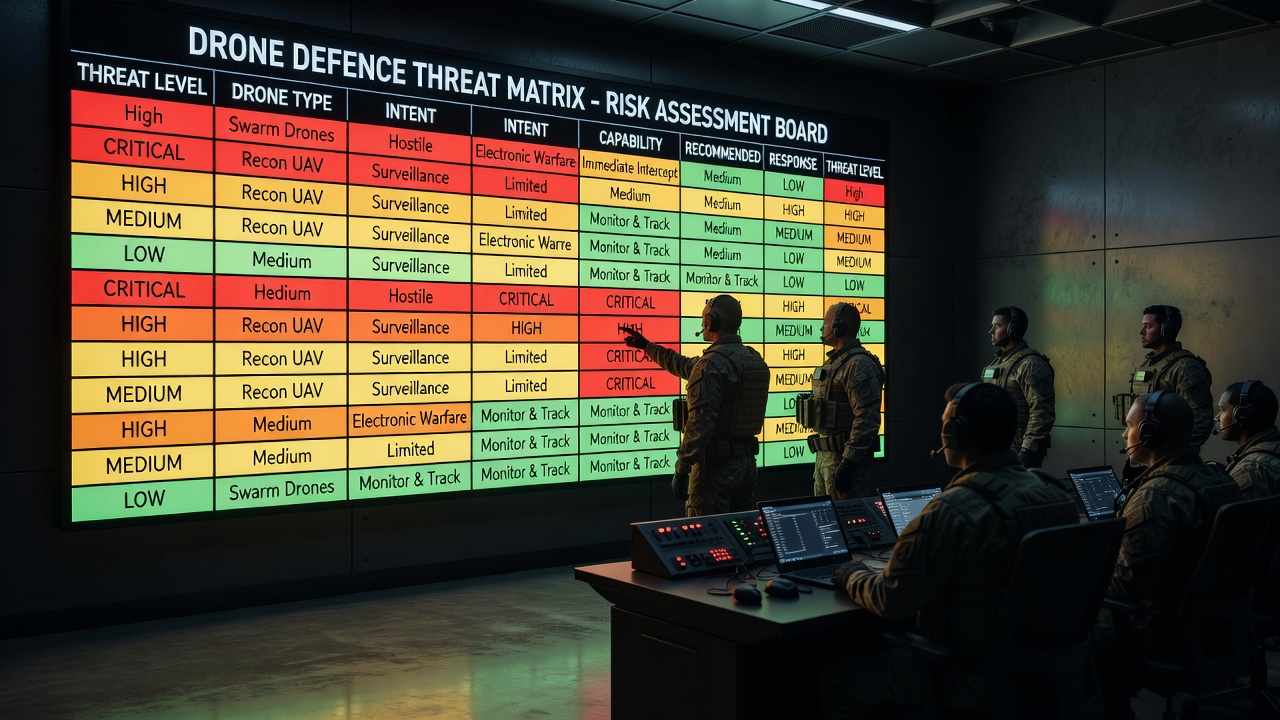
We pre-answer every objection

How we kill the risk.

  • Magnet supply → dual-source ferrite / iron-nitride, strategic stock, and magnet-free R&D.
  • One supplier → a second source qualified; spares and tooling held on-shore.
  • Capital → non-dilutive grants first; equity only to close the round.
  • Regulation → built to IAA / EASA UAS rules from day one.
  • Neutrality → lead civilian dual-use; defence only later, as an EU consortium partner.
  • Demand → 30+ Irish missions plus an export-market swarm — never one customer.
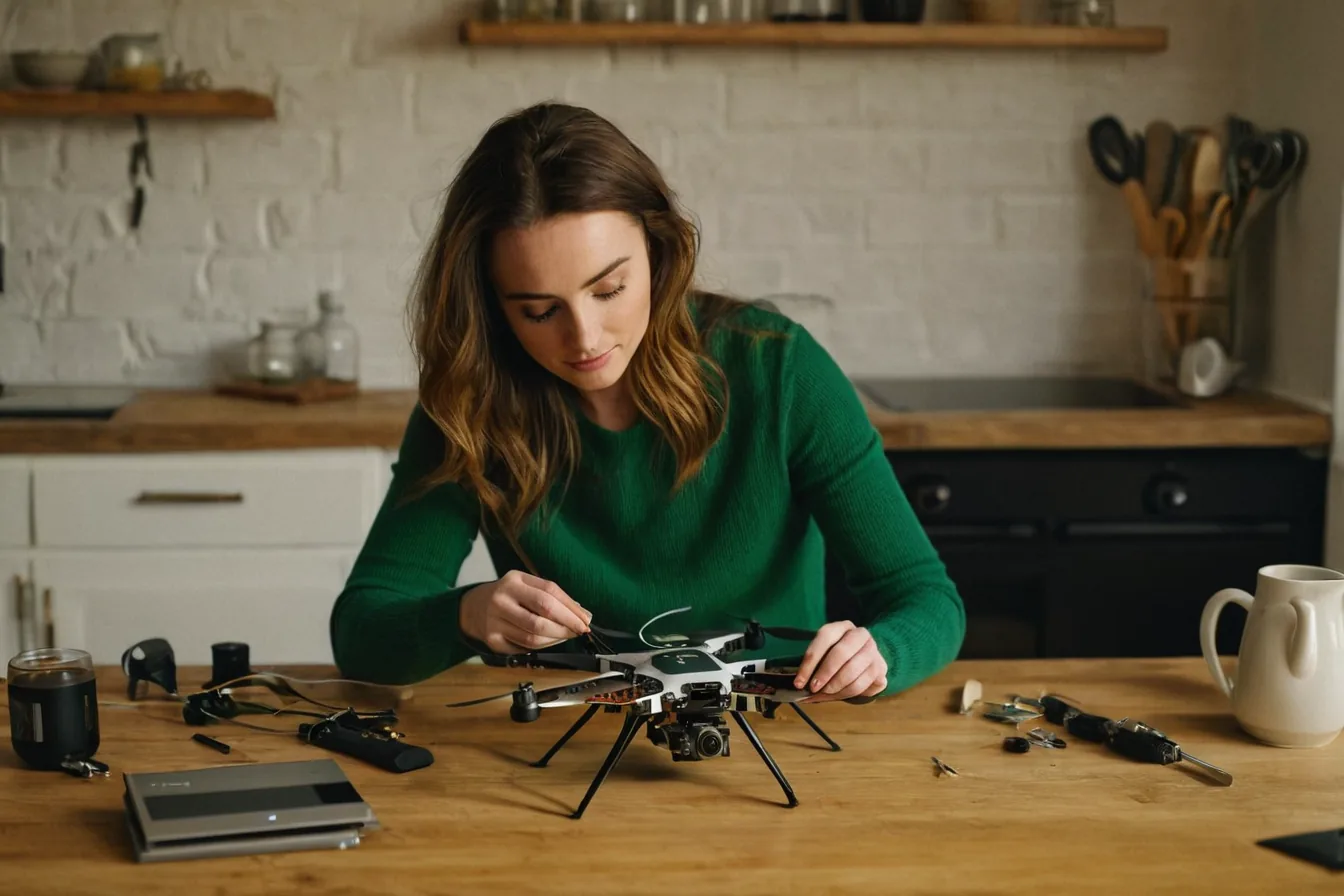
Full register held internally — 30 risks, each with a mitigation · what we measure: 10+ jobs · €1M/3yr · ≥98% first-pass · ~5-mo payback (modelled)
The State's checklist · every box mapped

Ticks every box.

Before any agency backs a project it runs the same checklist — eligibility, regulation, procurement, climate, governance, region. We mapped all six to a named Irish or EU rule and built to it. Status below is aligned / route-mapped — honest, not "already certified".

6 / 6State gates mapped
namedrule behind each
civil-firstneutrality-safe
data-roomfull sources
✓ Funding eligibilityHPSU · Údarás-ledManufacturing + exportable IP + 150 jobs clears every HPSU floor; Donegal sits in the Border regional-aid area. (Enterprise Ireland · Údarás na Gaeltachta · SA.101399)
✓ Drone regulationEASA · IAABuilt to an EASA C-class with CE marking; operations on the Specific-category SORA path. (Reg (EU) 2019/945 & 2019/947 · IAA)
✓ Public procurementGPP · MEATGreen Public Procurement is now mandatory — the precision-ag story fits; tax-clearance & eTenders-ready. (OGP Circular 17/2025 · Revenue)
✓ Climate targetsCAP 2025Precision-ag & afforestation MRV serve the legally-binding 51% / agri −25% targets the EPA says are off-track. (Climate Action Plan 2025 · EPA)
✓ GovernanceCRO · RBO · HSA · DPCCompany, beneficial-ownership, tax-clearance, health-&-safety and data-protection — all pre-ticked. (CRO · RBO · Revenue · HSA · DPC)
✓ Region & GaeltachtPI 2040 · GaeilgeA Donegal Gaeltacht plant hits the "growth outside Dublin" mandate, the Atlantic Economic Corridor, and an Irish-language-in-the-workplace commitment. (Project Ireland 2040 · Údarás)

Each box maps to a named Irish/EU rule — full citations in the data-room annex.

In plain terms — we don't ask the State to make an exception; we already fit the rules it applies to everyone.

The funding architecture · honest by design

No single grant covers €75M.

And we know it. At this scale a project is a "Large Investment Project" under EU state-aid rules — grants are capped and the rest is blended. So we structure it as a stack: a non-dilutive grant base, strategic & sovereign equity, matched private capital and asset finance. Capital follows proof.

Non-dilutive grants Non-dilutive grants: ≈ €11M ≈ €11M · grant base Strategic + sovereign equity Strategic + sovereign equity: ≈ €38M ≈ €38M · ISIF + strategic Matched private Matched private: ≈ €15M ≈ €15M · matched private Debt & asset finance Debt & asset finance: ≈ €11M ≈ €11M · SBCI / EIB Illustrative split of a €75M programme — set with advisers. Hover / tap a bar.
€75Mtotal programme
≈ €2.2Mself-funding Phase 1
GBERstate-aid-compliant
one laneindigenous · Údarás-led

Tranche sizes illustrative/modelled. Údarás (lead) · Enterprise Ireland · DTIF (R&D consortium) · ISIF · SBCI/EIB. Regional-aid ceiling per Commission Decision SA.101399; large projects require EU notification.

For the State — a credible blended structure that respects the state-aid rules, not a single cheque that breaks them.

Cleared for take-off · the regulatory path

Built to the rulebook.

Two regulated roles, one clean path. As a manufacturer we build to an EASA class with CE marking; as an operator we fly in the Specific category on a documented risk assessment — mapped to the rules, not hoping to be waved through.

As manufacturer
EASA C-class label — Reg (EU) 2019/945
CE marking + EU Declaration of Conformity
NB Notified-Body assessment for C1–C3
EU magnet-free, EU-content roadmap — export-clean
As operator
SORA Specific category · STS-02 (C6) for BVLOS
IAA operator registration + Remote Pilot Competency
LUC self-authorising operator certificate (goal)
DATA GDPR DPIA + NIS2 by design
EU Drone Strategy 2.0Ireland's National UAS Framework · Aug 2025EASA · IAA · DPC

Honest note: Ireland has no live U-space zone yet, so BVLOS today is case-by-case SORA — the framework is standing up now. Status: route mapped, not yet certified.

In plain terms — every flight and every airframe has a named European rule behind it, and we're built to clear it.

Delivering the State's own targets

We help Ireland hit its own numbers.

The hardest, most behind targets in Irish law sit in agriculture and land use — and the State openly says it's off-track, with a measurement gap. Precision-ag and afforestation MRV drones are a delivery mechanism for the very numbers the State has already committed to.

51%GHG cut by 2030 · in law
−25%agriculture target
8,000 ha/yrafforestation goal
off-trackEPA projection
AGRI variable-rate inputs → fertiliser efficiency, a named MACC measure for the −25% cut
MRV drone survey closes the State's admitted measure-report-verify tooling gap
GPP Green Public Procurement is now mandatory — the buyer rules favour this story
NEUTRAL civil-first & dual-use; safe anchor = Critical Seabed Infrastructure Protection (PESCO)

Climate Action Plan 2025 · EPA off-track projections (2025) · OGP GPP Circular 17/2025 · PESCO. Targets are the State's own; our contribution is a delivery tool, modelled.

For the country — we don't ask the State to bend its rules; we help it hit the targets it has already set — and stay inside our neutrality.

Business model · proposed

You don't buy the drone. Ireland does.

The model we propose: drones are leased or licensed to farmers, councils and operators — never sold outright. The fleet stays owned by the Irish State. That turns a one-off sale into a decade of recurring national revenue, and gives every unit sovereign anti-theft protection: geo-locked, remotely disabled, worthless if stolen.

Leasednot sold
State-ownedsovereign fleet
Geo-lockedtheft-proof · remote disable
Recurringincome for a decade
ASSET every drone is collateral the State still owns — financeable and insurable
CONTROL geo-fence + remote kill-switch makes a stolen drone a paperweight
REVENUE lease + service + data — one airframe earns for ten years, not one sale
PLATFORM the same motor feeds the anthroid.ch robotics build category — one factory, many markets

Model proposal — terms to be set with the State. Anti-theft via geo-lock + remote disable; recurring-revenue and asset-ownership figures modelled.

For the State — own the fleet, lease the capability, keep the revenue and the control in Irish hands.

The platform play · vision

Replant Ireland. Outrun Japan.

The motor is a platform, not a product. The same drive feeds robotics (anthroid.ch); the same fleet, AI-routed, can replant Ireland — autonomous afforestation toward the 8,000 ha/yr target the State is missing. Japan took 25 years to build a $1.9bn drone economy; we copy the proven demand and leapfrog with modern AI — software-defined fleets that get better with every update.

1 platformmotors → drones → robots
AI-routedfleet learns each flight
Replantautonomous afforestation
Leapfrogskip to modern AI

Vision / roadmap — afforestation and robotics adjacencies are staged, bankrolled by near-term cash. Japan figure: $1.9bn drone economy (cited). AI claims are capability we build toward, not a guarantee.

In plain terms — one Irish platform that compounds: each market we enter funds the next, and the fleet keeps getting smarter.

Why it works · first principles

30 reasons, plainly.

01 Capital-light: one €37k machine winds 100–300 motors/hr — demand, not capex, is the limit
02 Lease-not-sell turns a one-off sale into a decade of recurring national revenue
03 State-owned fleet = sovereign control: geo-lock + remote disable makes theft pointless
04 Asset-backed: every drone is collateral the State still owns — financeable, insurable
05 Value chain: €37 motor → €120 certified → €15–20k finished drone (20×+ multiplier)
06 Open & repairable lowers support cost; key Irish patents keep the margin home
07 Butter-knife modularity = field repair by anyone → near-zero downtime
08 Repair-as-revenue: a serviced fleet bills forever; spares & modules compound
09 Same motor platform feeds robotics (anthroid.ch) — one factory, many markets
10 Software-defined fleet: every drone improves when the AI model updates
11 Data flywheel: each flight trains better routing, agronomy & inspection models
12 Replant Ireland: autonomous afforestation toward the missed 8,000 ha/yr target
13 Precision-ag cuts inputs 20–30% → serves the legally-binding agri −25%
14 Import substitution: €14–22k kept onshore per drone vs buying foreign
15 Greenfield: Ireland makes ~0% of its own; 1% of a €31.6bn EU market = €316M
16 Outrun Japan by leapfrog: copy 25 years of demand, skip to modern AI autonomy
17 Neutral-safe: civil-first, dual-use, EU-aligned — no political blocker to backing
18 Phased capital: grants prove Phase 1 (~€2.2M), equity scales — money follows proof
19 Gaeltacht jobs: 150 skilled + a renewable repair & training supply chain
20 Every household learns to build one at drones.irish/learn/ — a national skill base
21 Night-sentry at rest: rooftop recharge + alerting → a passive public-safety layer
22 Storm-survivable: ground-anchor, magnetic-dock, or dive to ride out Atlantic swells
23 Hot-swap modules: a grounded drone is minutes from flying again
24 Standard class → certify once, sell everywhere (EASA C-class + CE)
25 Recurring lease de-risks the grant — it's a loan the country repays itself
26 Sovereign supply chain: spares + tooling on-shore → immune to export-control shocks
27 Magnet-free roadmap removes dependence on imported rare-earth magnets
28 Wet-lease abroad (DaaS): export earnings without exporting the asset
29 Edge-AI onboard: act locally, sync centrally — resilient, low-bandwidth
30 One platform compounding: motors → drones → robots → services → data

First-principles factors; numeric items modelled or sourced as elsewhere in the deck. Scroll for all 30.

The throughline — a capital-light, State-owned, AI-compounding platform that keeps the value in Ireland.

Repairable by design

Fixed with a butter knife.

Plug-and-play modularity: at the kitchen table, pop a part out with a butter knife, click a new one in, and away it flies — no problem. It's open and easy to reverse-engineer on purpose, so anyone can repair it; the core inventive steps are protected by Irish patents, so the profit stays with the Irish people.

Plug & playswap a module, fly
Openrepairable by anyone
Patentedcore steps protected
Uptimeminutes, not weeks

Open, repairable architecture; key inventive steps protected by Irish patents (pending). "Reverse-engineerable" means serviceable by owners — not that the IP is unprotected.

For every household — a drone you can actually fix yourself, owned by the nation, protected for the nation.
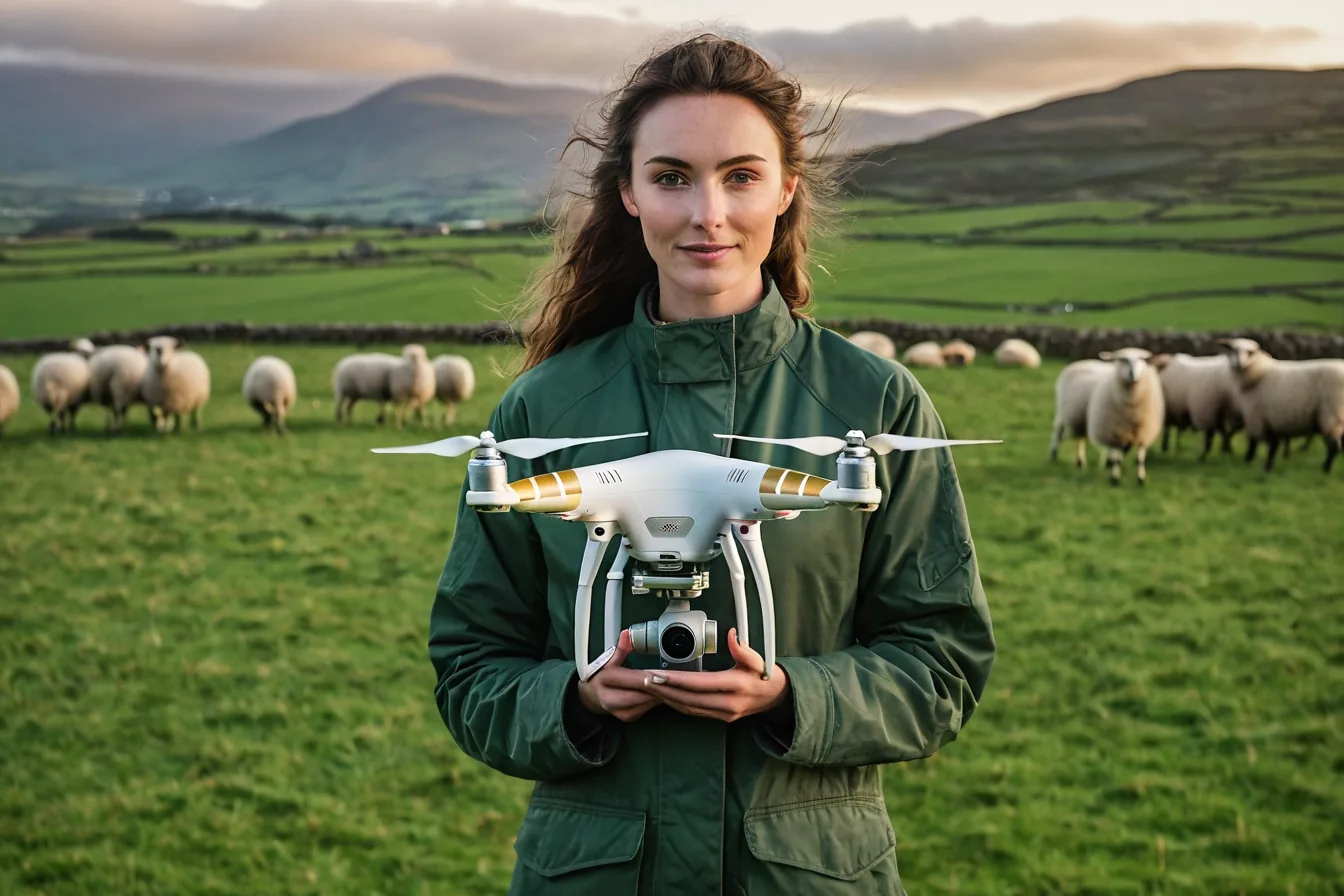
A drone for the community · proposed

A job — and a drone — for everyone.

The aspiration: a shared community drone in every parish to farm, inspect and watch over the place — and every school and household can learn to build and repair one at drones.irish/learn/. Hands-on with your own rugged, simple "Kalashnikov-class" farm drone: take it apart, put it back, put it to work or outsource it.

/learn/hands-on course
Every schoolbuild & repair
Every parisha shared drone (pilot)
A jobfor everyone

Community pilot & curriculum — a proposed programme, not a committed promise. "Free drone for every household" is an aspiration we would pilot with the State.

For the people — skills, work and a shared tool in every community — built and owned in Ireland.

At rest, still working

A quiet sentry by night.

As they rest on rooftops and recharge, the drones can act as a privacy-respecting neighbourhood-watch — monitoring silently and alerting to incidents as they happen, so communities feel guarded at night. In strong weather they anchor to the ground, dock to a magnetic surface, or dive underwater to ride out swells — so the Atlantic never blows the fleet out to sea.

Rooftoprecharge & watch
Alertincidents, not surveillance
Anchor / docksurvive storms
Diveride out swells

Neighbourhood-watch alerting only — GDPR-bound, civil, not autonomous surveillance or a crime-reduction guarantee. Storm-anchoring, magnetic-docking and water-landing are engineering goals on the roadmap.

In plain terms — a fleet that earns by day, guards by night, and survives an Atlantic storm.

The people of the programme

Built by Irish hands.

Every farm
Our harbours
Dairy country
Every school
Clean energy
Fix it yourself
On the land
Orchard & crop
Our heritage

Illustrative imagery. A skilled, renewable workforce — building, flying and repairing Irish drones in every community.

For the country — a job, a skill and a drone in every parish — made in Ireland.

The ask

Let's build it. Now.

Engineering-first, Ireland-resident operations. The threat is named, the demand is funded, the line is costed. We are ready to deliver the sovereign capability the State has called for.

hello@drones.irish · drones.irish

The 100-mile view

Now you know — end to end.

Raw steel & copper Stamp & wind Rotor & magnetise Press & balance Test · Kv / thrust Drone integration Calibrate & pack Deploy · 30 Irish missions

From a 0.20 mm steel lamination to a flight-ready Irish drone serving the coast, the fields and the State — one line, one island, one sovereign capability. That is the whole machine, on one screen.

A career built at home

Built here, with pride.

From a 0.20 mm steel lamination and a single strand of enamelled copper to a finished drone in her hands — this is high-skill engineering, in Donegal, through Irish, for the world.

"You are only as strong as your 0.20 mm laminations, your enamel-coated winding and your casings." — the craft at the heart of every motor.

Dúchas · heritage

In the spirit of Colm Cille.

Saint Colm Cille was born at Gartan, in this very corner of Donegal, fifteen centuries ago — and carried Irish learning out to the world. We build here in that same spirit: Irish hands, the Irish language, Irish ambition — protecting our seas, tending our land, and offering our skill to the world with warmth and openness.

Colm Cille (Columba) · born Gartan, Co. Donegal, c. 521 AD
Go raibh maith agat

Thank you — for reading this far.

This is a real plan, built on real numbers, for a real need. If it makes sense to you the way it makes sense to us, then the best day to start was yesterday — and the next best day is today. We would be honoured to build it together.

drones.irish · hello@drones.irish · Le meas

Éire · le chéile

Made in Ireland. For the world.

A sovereign capability, built by Irish hands — protecting our seas, tending our land, and lighting the way forward. Let's build it together.

Go n-éirí an bóthar leat · drones.irish

swipe / arrow keys →